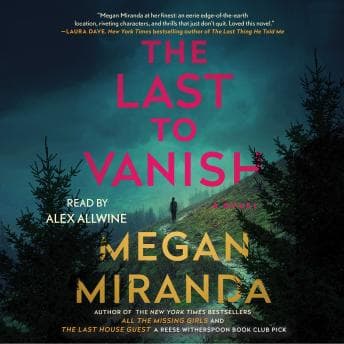

So the Booklist blurb on this one compares it to The Haunting of Hill House and The Shining. I need to address this immediately: no. Absolutely not. I love Megan Miranda's work — she writes sharp, atmospheric suspense — but invoking Jackson and King sets expectations this book was never trying to meet. That comparison did Last to Vanish dirty, honestly, because what it actually is? A solid small-town mystery with genuine creep factor. And that should've been enough.
I started this one on a late shift at the library, alone in the stacks after closing, reshelving holds. The fluorescent lights were buzzing, the rain was hitting the windows sideways, and Cutter's Pass — this fictional North Carolina mountain town where hikers keep vanishing near the Appalachian Trail — felt uncomfortably plausible. That Appalachian atmosphere reminded me of Demon Copperhead, which captures mountain country with the same unflinching honesty. Small towns with secrets they'd rather bury than solve? I live in Oregon. I know that energy.
The Town That Swallows People Whole
Miranda does something clever with structure here. Abby manages The Passage Inn, and she's this fascinating in-between character — not a local, not a visitor, just... present. She's been there a decade and still doesn't fully belong. When journalist Landon West disappears while investigating the town's string of vanishings, and then his brother Trey shows up demanding answers, Abby starts pulling threads she probably should've left alone. The slow revelation of how little Abby knows about her own neighbors and coworkers — people she sees every single day — that's where the real horror lives.
And I do mean slow. This is a commitment of a slow burn. The first three hours are setup, character introduction, atmosphere-building. If you're the kind of listener who needs a body by chapter two, you're going to struggle. I almost checked out around hour two myself, which is rare for me at under ten hours. But Miranda is laying groundwork — the geography of Cutter's Pass, the waterfall trail, the way information moves (or doesn't) through a town that's decided collectively to stop asking questions. By the time the tension actually ratchets up, you realize she's been tightening the screws so gradually you didn't notice your shoulders were at your ears.
The final twist involving the original Fraternity Four disappearance genuinely caught me off guard. I won't spoil it, but Miranda earns it. The pieces were all there; I just wasn't looking at them right.
Alex Allwine and the Patience Problem
Here's where this audiobook gets divisive, and I land somewhere in the messy middle. Allwine's narration is competent. She gives Abby a no-nonsense internal voice that fits the character — Abby's not dramatic, she's observant and guarded, and Allwine reads her that way. The distinction between Abby's spoken dialogue and her internal processing is clear and consistent. When fear creeps in, Allwine adjusts — there's a tightness, a held-breath quality that works.
But — and this is a real but — the pacing of the narration compounds the pacing of the prose. Miranda already writes slow. Allwine reads measured. Together, they create stretches that feel like wading through fog. I can see why some listeners bailed entirely. I can also see why others found it hypnotic. It depends entirely on your tolerance for atmosphere over action.
She doesn't commit the way the best horror narrators do. There are moments where the text is begging for a shift in energy — a dropped voice, a quickened cadence — and Allwine stays even. Steady. It's professional. It's also a missed opportunity. The narrator commits — that's rare, and I can't quite say it here. She shows up. She does the work. But she doesn't disappear into it.
At 1.25x speed, honestly? The whole thing clicks better. The pacing feels intentional rather than sluggish, and Allwine's measured delivery gains a sense of urgency it needed.
Who Gets Lost in Cutter's Pass (And Who Walks Away)
If you love atmosphere-first mysteries — the kind where setting is basically a character — this works. If you're a Miranda fan, this might be her tightest construction. If you need action, if slow burns leave you cold, if you want a narrator who's going to grab you by the throat — skip the audio and read the print. Seriously. The story deserves your attention, but the audio format amplifies every pacing issue.
My podcast listeners who loved The Last House Guest are going to eat this up. The ones who thought that book dragged? They'll feel the same way here, times two.
Shirley (My Cat) Was Unimpressed. I Was... Mostly Satisfied.
Look, I wanted to love this more than I did. The bones are excellent — Miranda understands that the scariest thing about a small town isn't what's hiding in the woods, it's what your neighbors decided to stop talking about. The final act delivers. But getting there requires patience the audiobook format tests more than the print would. It's a three-and-a-half-star listen that's probably a four-star read, and that gap matters when you're spending a credit.