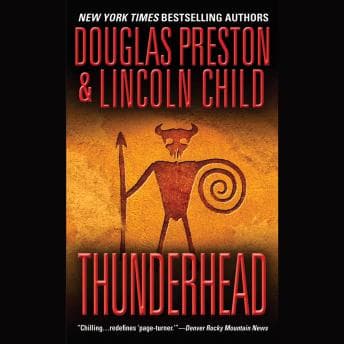

What happens when you hand two thriller writers a premise straight out of Indiana Jones and let them run wild through the canyon country of southern Utah?
You get Thunderhead, and honestly, you get something better than it has any right to be.
I was walking the lakefront with Denise last Saturday morning - one of those early fall Chicago days where the wind off the lake is just cold enough to make you question your life choices - when this book really sank its teeth in. We'd been walking in comfortable silence for maybe twenty minutes, and Denise finally pulled out one of my earbuds to ask if I was okay because apparently I'd been muttering "don't go in there" under my breath. Nora Kelly was about to enter a slot canyon that I knew - I just knew - was going to go sideways.
The Desert Is the Real Antagonist
Preston and Child understand something that a lot of adventure writers miss: the setting isn't wallpaper. The red rock desert of southern Utah in this book is a character with agency and malice. The way they describe the slickrock, the flash flood dynamics, the sheer claustrophobia of navigating slot canyons so narrow you have to turn sideways - it's not just scene-setting, it's the engine of dread. Nora Kelly's expedition to find Quivira, this legendary lost Anasazi city her vanished father supposedly located, feels genuinely dangerous in ways that have nothing to do with the human villains. The land itself wants to kill these people.
And the archaeological detail is real. Preston has actual field experience - he spent time at dig sites - and it shows. The protocols Nora's team follows, the way they catalog finds, the professional rivalries between the expedition members - this stuff has texture. My students would hate this. I love it. There's a patience to the buildup that reminds me of early Crichton, where the science isn't decoration, it's load-bearing.
The mystery of Nora's father's letter, written sixteen years before the story begins, is the emotional spine of the thing. It's not just "find the lost city" - it's a daughter trying to understand a man who disappeared when she was young, reading his words as both clues and a kind of posthumous conversation. That's a surprisingly human engine for what is, let's be honest, a treasure hunt thriller. I noticed a similar emotional trick at work in Where She Went - where the surface genre machinery is almost a decoy for the real story underneath, which is just someone trying to reconstruct a relationship through the pieces left behind.
Scott Brick and the Falsetto Problem
Let's talk about Scott Brick. I've listened to enough of his work to know what you're getting: a deep, authoritative male voice that does suspense extremely well. His pacing through the canyon sequences is genuinely good - the narrator understands that pause is punctuation, and Brick uses silence in the tight, dangerous moments the way a horror director uses darkness. When the expedition is deep in Serpentine Canyon and things start going wrong, his delivery earns the tension Preston and Child built on the page.
But here's the thing. His female voices. Specifically, his approach to Nora Kelly, who is the protagonist. He goes falsetto, and it's... look, it's not great. It's the kind of thing where the first time you hear it, you wince, and then you spend the next few hours deciding whether you can live with it. I could. Barely. By hour six or seven, my brain had mostly adjusted, the way you stop noticing a slightly crooked painting after you've been in the room long enough. But I understand the listeners who couldn't get past it. When your lead character is a woman and your narrator makes her sound like he's doing a bit at a dinner party, that's a real problem.
The male characters, though? Brick nails them. The distinction between the various expedition members - the arrogant academic Sloane, the quiet competence of the support team, the menace in the antagonist's voice - that's all solid work.
Who Should Make the Trek
If you loved Riptide or any of the other standalone Preston and Child novels, this is their most atmospheric one. If you're a Clive Cussler reader looking for something with a little more literary weight and a lot more archaeological credibility, this is your next listen. If you're coming from literary fiction and you want a gateway into smart adventure writing - the kind where the authors actually respect your intelligence - Thunderhead is a surprisingly good entry point.
Skip it if: you cannot tolerate a male narrator doing female voices poorly, because that's about 40% of the dialogue. Or if you need breakneck pacing from page one - this is a slow burn that takes its time setting up the expedition before the desert starts trying to kill everyone.
Eighteen hours is a commitment. But at 1.0x - because the prose deserves to be savored, and because Preston and Child actually know how to write landscape description that earns its length - it's a satisfying one. Worth pausing the faculty meeting for. (Sorry again, Principal Martinez.)
The Assignment I'd Give My Students
This reminds me of what Hemingway said about prose being architecture, not interior decoration. Thunderhead is built like a canyon itself - narrow entrance, widening into something vast and a little terrifying, with no easy way back out once you're committed. It's not perfect. The female voice issue is real, and some of the character work is more functional than deep. But as a piece of adventure writing performed by someone who genuinely understands how to build suspense with his voice? It earns its place on the shelf. Or in the earbuds. Same thing these days.