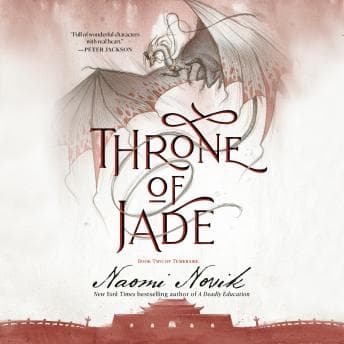

Naomi Novik wrote a Napoleonic War novel where the most interesting diplomatic crisis isn't between England and France — it's between a British naval captain and an imperial Chinese delegation arguing over custody of a dragon.
Let me back up. I started Throne of Jade on a Saturday morning walk along the lakefront with Denise, and she kept pulling out one of my earbuds to ask why I was grinning. The answer was Temeraire — a Celestial dragon who reads political philosophy, argues about the rights of dragons with the earnestness of my sophomore honors students debating Animal Farm, and genuinely cannot understand why British dragons are treated like military equipment instead of citizens. He's the moral center of this book, and Novik knows it.
Patrick O'Brian's Master and Commander If the Ship Had Opinions
Here's what Novik is really doing with this series, and it becomes crystal clear in book two: she's writing an Aubrey-Maturin novel where the ship is sentient and has feelings about colonialism. The first half of Throne of Jade is almost entirely a sea voyage — Laurence and Temeraire aboard the Allegiance, a dragon transport ship, crossing from England to China with a Chinese prince who wants Temeraire returned. And I'll be honest, some listeners find this section slow. They're not wrong about the pacing. The plot doesn't so much advance as it accumulates. Political maneuvering. Shipboard tensions. A poisoning attempt that feels almost incidental to the larger question Novik keeps circling: What does it mean when an empire treats a thinking, feeling creature as property to be gifted or reclaimed?
This is why we still read the classics — because the questions underneath the adventure are always the ones that matter. Novik isn't subtle about it either. When Temeraire arrives in China and sees dragons walking freely through cities, dining with humans, holding positions of authority, his shock at the contrast with England hits like a gut punch. My students would hate how slowly Novik builds to that moment. I love it. The prose deserves to be savored.
Simon Vance Understands That Pause Is Punctuation
Look, I've listened to a lot of Simon Vance. The man narrates half the historical fiction on Audible, and sometimes that means he's on autopilot. Not here. What he does with Laurence is subtle but essential — there's this stiff-upper-lip formality in every line, the kind of controlled Regency diction that tells you everything about a man who'd rather face a firing squad than break protocol. But when Laurence speaks privately to Temeraire, Vance softens. Not dramatically. Just enough. The warmth creeps in around the edges of his delivery, and you hear a man who loves this dragon more than he can articulate within the confines of his own emotional vocabulary.
And Temeraire himself — Vance gives him this slightly elevated, almost academic cadence. Not childish, not quite fully adult. It's the voice of someone who is extraordinarily intelligent but still learning how the world works, and the gap between Temeraire's intellectual capability and his emotional naivety is where the real drama lives. When Temeraire asks Laurence why English dragons don't simply demand better treatment, and Laurence has no good answer, Vance lets the silence land. That silence is doing more work than dialogue could.
The Chinese characters get careful treatment too — Prince Yongxing's formal precision, the servants' deference — though I'll note the research turned up nothing specific about accent work here, and I won't pretend I caught fine distinctions I didn't. What I can say is that Vance keeps the large cast legible, which matters when you're half-listening during a faculty meeting about standardized testing. (Principal Martinez, I promise that was only once. Maybe twice.)
The Middle Book Problem — And Why It Doesn't Quite Sink This One
Let's talk about what some readers flag: this is a middle book, and it feels like one. The first third is setup. The sea voyage, while atmospheric, could lose twenty minutes without consequence. And the China sequences, while fascinating as worldbuilding, resolve with the kind of convenient political pivot that feels rushed after all that deliberate buildup. I get the criticism. If you came here for dragon combat, you'll be rationing your patience — there's maybe one significant aerial sequence in eleven hours.
But I think the people disappointed by the pacing are looking for the wrong book. Throne of Jade isn't an action sequel. It's a culture-shock novel disguised as fantasy. If you loved His Majesty's Dragon for the battles, this is its contemplative, politicized sibling. If you loved it for Laurence and Temeraire's relationship — the way a rigid military man slowly reorganizes his entire worldview around a creature he was never supposed to bond with — then this is the book where that relationship gets tested in ways that actually matter.
Who Gets an A, Who Gets Excused
This is for readers who want their fantasy to ask questions about empire and belonging, who don't mind a slow boat to China (literally), and who've already fallen for Temeraire's peculiar mix of draconic dignity and philosophical curiosity. If you need plot momentum every chapter, borrow it from the library first. But if you're the type who listens at 1.0x because the author chose those words — and Novik chose hers carefully — this is worth eleven hours of your time.
I finished it at 11 PM, grading essays on Things Fall Apart, and the thematic overlap between Achebe and Novik hit me sideways. Empire showing up uninvited. Culture as leverage. The people caught between. My students would probably tell me I'm reaching. They'd be wrong. That same collision of occupation and identity is what makes Anne Frank: The Diary of a Young Girl so devastating in audio — another voice caught between a world that insists on defining her and her own stubborn insistence on being fully human.