
The Cure for "Floating Quote Syndrome"
I have graded roughly 12,000 essays in my career. (My optometrist says this is why I need bifocals, but I blame grading on iPads). The number one crime committed by teenagers—and let's be honest, most adults—is what I call "Floating Quote Syndrome." They drop a quote into a paragraph like a grenade and run away, hoping the explosion makes a point for them.
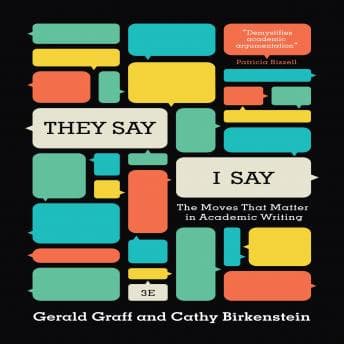
They Say, I Say is basically the antidote to that mess.
I usually assign chapters of this book to my AP Lang students, and they usually pretend to read it. But listening to the audiobook? That was a new experience for me. I put this on while driving down Lake Shore Drive, dreading a stack of papers waiting on my desk, and honestly? It was weirdly soothing. Like hearing the secret code of academia explained in plain English.
The Secret Handshake of Academia
Here's the thing about academic writing—it's a game. It has rules. Graff and Birkenstein aren't trying to teach you grammar; they're teaching you the moves. The "moves that matter."
Listening to the core philosophy—that writing is a conversation, not a monologue—hit differently in audio format. When you hear the templates read out loud ("On the one hand, X argues... On the other hand, I contend..."), it sounds like actual human speech. It reminds you that before we wrote essays, we sat around fires and argued.
The authors break down how to summarize someone else's argument before pivoting to your own. It sounds simple. It is simple. But 90% of people don't do it. They just shout their opinion. (Check Twitter/X if you don't believe me).
There's a section on "metacommentary" that is absolute gold. It's basically teaching you how to tell the reader how to read your writing. My students think this is "cheating" or "stating the obvious." I tell them it's clarity. Listening to it, I found myself nodding along, wishing I could beam this directly into my students' AirPods.
Two Voices, One Classroom
We have two narrators here, Cyndee Maxwell and Tony Craine.
Are they doing character voices? No. Is this a dramatic performance? Absolutely not.
But look, it's a textbook. If they tried to jazz this up with sound effects or emotional acting, it would be unbearable. Maxwell and Craine play it straight. They sound like that one professor in college who actually wanted you to pass. Clear, articulate, warm but firm.
The pacing is spot on for educational content. Not too fast. You have time to process the "templates" they suggest.
However—and this is a big however—listening to lists of fill-in-the-blank templates can get a little repetitive. "X states that blank, yet I would argue blank." It works visually on the page better than it does in your ear. There were moments where I zoned out a bit during the template lists. (Sorry, Gerald Graff. I still love the book).
Who This Is For (And Who Should Skip It)
If you're a student struggling to hit a word count or make your point sound "smart," listen to this. Seriously. It explains the logic of writing better than I can in a 45-minute period. If you're just a person who wants to argue better in emails or meetings? Still worth it. It teaches you to listen before you speak (or write). But if you need a physical reference to flip back to those templates mid-essay, grab the print version instead—audio works better for understanding the philosophy than memorizing the formulas.
The Bell's About to Ring
For a deeper dive into the historical context of argument and rhetoric, Souls of Black Folk demonstrates how Du Bois engaged with opposing viewpoints while advancing his own thesis.
I'm probably going to play snippets of this in class next semester. The kids will roll their eyes. But maybe, just maybe, one of them will finally stop dropping floating quotes. A teacher can dream.