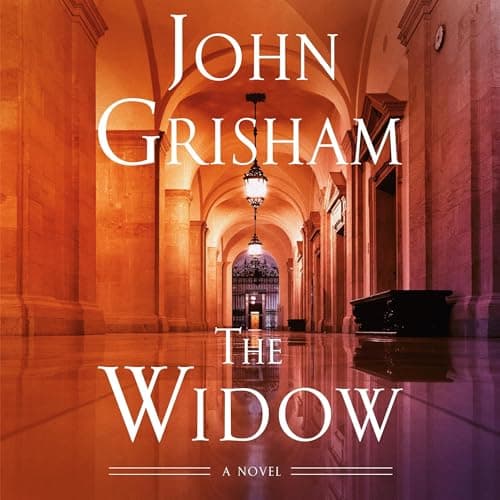

John Grisham writing a whodunit instead of a straight legal thriller is the kind of creative pivot that either reinvigorates a career or exposes its limitations. With The Widow, he lands somewhere in between — a book that's genuinely fun when it's firing on all cylinders but frustratingly padded when it's not.
Here's the setup: Simon Latch is a small-town Virginia lawyer barely keeping the lights on when Eleanor Barnett, an elderly widow with a secret fortune, walks through his door. What starts as a straightforward estate planning gig spirals into something much darker. When Eleanor ends up hospitalized after a car accident, Simon finds himself accused of murder, and the circumstantial evidence is stacking up against him like bricks in a wall. The only way out is to find the real killer himself.
Grisham knows how to build a legal world you can practically smell — the dusty courthouses, the small-town gossip networks, the way money warps relationships in rural communities. The first half of the audiobook takes its time establishing all of this, and I mean it really takes its time. If you're listening during a long drive, this is fine. The atmosphere settles around you like a Virginia summer. But if you're trying to squeeze in chapters during a lunch break, you might find yourself checking how many hours remain more often than you'd like.
The courtroom scenes are where The Widow comes alive. Grisham has always been at his best when characters are sparring across a courtroom, and the trial sequences here carry genuine tension. You can feel Simon's desperation as the case tightens around him, and the legal maneuvering is sharp enough to keep any thriller fan engaged. The whodunit element adds a layer of uncertainty that Grisham's more straightforward legal dramas sometimes lack — you're genuinely unsure who's pulling the strings behind Eleanor Barnett's tangled affairs.
But that mystery structure also creates the book's biggest problem. Grisham pads the middle section with excessive internal monologues from Simon, circling the same anxieties and suspicions without advancing the plot meaningfully. And the ending — without spoiling anything — arrives with a twist that some listeners will find clever and others will feel came out of nowhere, as if Grisham ran out of runway and needed to land the plane fast. I fell somewhere in the middle. The reveal made logical sense when I thought back through the clues, but the emotional payoff didn't quite match the fourteen-hour investment.
Now, about Michael Beck's narration. This is where the audiobook experience gets genuinely divisive, and I think both camps have legitimate points. Beck nails the Southern atmosphere. His male characters are well-differentiated, and his courtroom delivery is strong — he captures the rhythm of legal proceedings without making them feel like a transcript reading. There's a steady tension in his voice that keeps the slower passages from flatlining completely.
However, his approach to female characters is a real problem. Beck adopts a nasal, whiny tone for Eleanor Barnett that might work in isolation for an elderly character, but then applies essentially the same vocal quality to nearly every woman in the book. Younger women, older women, confident women, nervous women — they all get variations of the same slightly grating voice. During longer stretches with female dialogue, it became genuinely distracting. I found myself wincing during scenes that should have carried emotional weight because the vocal characterization kept pulling me out of the story.
The glottal fry at the end of sentences is the other recurring issue. It's subtle at first, but once you notice it, you can't un-notice it. Over fourteen hours, these small tics accumulate into real irritation.
Here's the thing though: if Beck's voice works for you — and it clearly does for many listeners — this is a strong audiobook experience. He genuinely inhabits the world Grisham created, and his pacing through the courtroom scenes is excellent. The production is clean with no technical issues to speak of.
Who Should Listen (And Who Should Skip)
If you love Grisham's courtroom mechanics and want a mystery twist layered on top, this'll scratch that itch — especially on a long road trip or a week of commutes. Skip it if you're impatient with slow-burn pacing or if same-voice female characters in audiobooks drive you up a wall.
The Widow is Grisham doing something slightly different within his comfort zone. It's not his best work, but it's far from his worst. The mystery element gives the familiar legal thriller structure a welcome jolt of unpredictability, even if the execution doesn't always match the ambition. White Cargo scratched a similar itch for me — that same slow-build tension where the atmosphere does heavy lifting before the plot fully ignites. Just know that you're signing up for a slow burn that occasionally sputters before it catches.