
I was standing in my kitchen, waiting for onions to caramelize—which, if you know anything about Indian cooking, takes an eternity—when Pete Banning walked into a church and shot the Reverend Dexter Bell.
Just like that. Cool. Calm. Collected.
And then? He says, "I have nothing to say."
As a behavioral psychologist, let me tell you: that phrase is my white whale. Nobody has nothing to say. Especially not a decorated WWII hero in 1946 Mississippi who just executed a preacher. Silence is a behavior. It's a wall. And I spent the next seventeen hours—yes, seventeen—trying to diagnose this fictional man while I meal-prepped for a week I wasn't ready for.
Here's the thing about The Reckoning. It's not really a legal thriller. If you're looking for the fast-paced, objection-your-honor adrenaline of The Firm, you're going to be disappointed. Though if you want Grisham doing what he does best—courtroom drama with actual stakes—Rogue Lawyer delivers that in spades. This is a character study of a man broken by war and bound by a toxic code of Southern honor. (My therapist would call this "maladaptive compartmentalization," and for once, she'd be right.)
The Psychology of Silence (and War)
Grisham does something risky here. He takes us out of the courtroom and drops us into the Bataan Death March. Literally.
About a third of the way through, the book pivots from a murder mystery to a brutal, visceral war survival story. And I mean brutal. I actually had to pause the audio during a jog along the Charles River because the description of the Japanese POW camps was so intense I forgot to breathe.
Some listeners complain this middle section drags. They call it filler.
Psychologically? It's essential. You can't understand why Pete Banning is a stone wall in 1946 without seeing him dismantled in 1942. The trauma explains the dissociation. It explains why death doesn't scare him. Grisham is showing us the architecture of a broken mind, brick by bloody brick. Fascinating, even if exhausting.
The Voice of the South
Let's talk about Michael Beck.
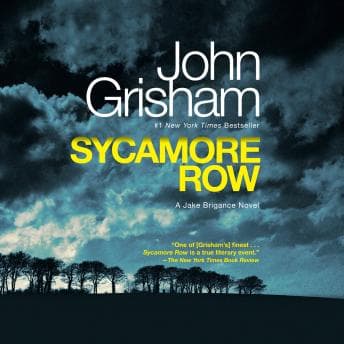
If you want to know what humidity sounds like, listen to this man. Beck does the same atmospheric magic in Sycamore Row, another Grisham novel where the Mississippi setting is practically a character. He doesn't just read; he creates an atmosphere. His voice has this thick, slow, molasses quality that fits the Mississippi setting perfectly. He nails the "Southern Gentleman" archetype—that polite, terrifying calmness that masks deep dysfunction.
But. (And there's always a but.)
Beck struggles with the women. It's a common issue with male narrators doing Southern Belles, and it grated on me. The female characters often sounded shrill or hysterical, leaning into stereotypes rather than nuance. My mother would have thrown a sandal at the speaker. It pulled me out of the immersion a few times, reminding me I was listening to an actor rather than eavesdropping on a family tragedy.
The "Why" Factor
The whole book hinges on the motive. Why did he do it?
I won't spoil it, obviously. But I will say this: the ending is polarizing. Some people hate it. They feel cheated.
Me? I sat with it for a long time. From a narrative perspective, it's abrupt. But from a psychological perspective? It tracks. Devastatingly, frustratingly human. It highlights how secrets fester and how the stories we tell ourselves about our families are often total fabrications.
Humans are messy, and Grisham didn't try to tidy it up for a happy ending.
Who Should Listen (and Who Should Skip)
This is a slow burn. Like, slow. It demands patience. It's a tragedy dressed up as a mystery, heavy on the history and heavier on the emotional baggage.
Listen if you want to understand the anatomy of a secret—the kind that rots a family from the inside. Skip if you just want a lawyer to win a case in the last five minutes.
(Now, if you'll excuse me, I need to go call my mother and ask her about family secrets. Just in case.)