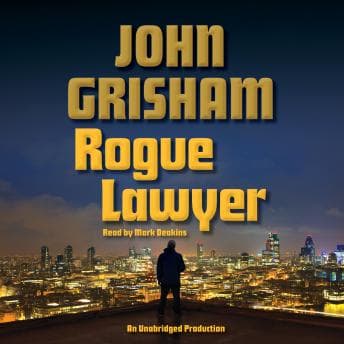

Let me cut to the chase - this isn't your typical Grisham. And honestly? That's both the best and worst thing about it.
So I'm driving back from a client meeting in Houston - three hours of Texas highway stretching out ahead of me - and I figure it's time to finally knock out another Grisham. The man's written enough legal thrillers to keep me busy through retirement. But Rogue Lawyer threw me a curveball I wasn't expecting.
Sebastian Rudd operates out of a bulletproof van with a driver who doubles as his bodyguard. He carries a gun, drinks good bourbon, and takes the cases nobody else will touch. On paper, this guy sounds like someone I'd want to grab a beer with. In practice... look, he's kind of a jerk. But here's the thing - he's an interesting jerk. The kind of morally gray character who makes you uncomfortable precisely because you find yourself nodding along with his twisted logic.
The structure here is different from what you'd expect. It's not one cohesive case building to a courtroom climax. It's more like... vignettes. Episodes. Sebastian bouncing from one nightmare client to the next - a kid accused of satanic murder, a crime lord on death row, a homeowner who shot at a SWAT team that raided the wrong house. Each case is its own little world. Some work better than others. The SWAT team story? That one hit different for me. (I've seen similar scenarios play out in real life, and Grisham clearly did his homework on how badly those raids can go wrong.)
Mark Deakins handles the narration, and I gotta say - he walks a fine line here. I've heard Deakins tackle completely different material in Scorch Trials, and the guy's got range—dystopian YA is a world away from legal thrillers, but he commits to both. Sebastian is written pretty cold on the page, almost detached from his own chaos. Deakins adds just enough humanity to keep you from completely writing the guy off. His character differentiation is solid. You always know who's talking, which matters when you're doing 75 on I-10 and can't exactly rewind easily.
Now, some folks found Deakins a bit cheesy. I get it. There's a certain dramatic flair to his delivery that won't work for everyone. But for my money, he kept me engaged through the slower stretches. And there are slower stretches - this is where it lost me a few times. The episodic structure means some cases just don't grab you the way others do. I found myself checking how much time was left during a couple of the middle sections. Not a great sign.
The pacing is uneven. Some chapters fly by - the courtroom stuff, the confrontations with prosecutors and judges, the moments where Sebastian's cynicism crashes headlong into the system's hypocrisy. Those are classic Grisham territory, and they work. But then you hit a stretch where Sebastian's personal life takes center stage - custody battles, relationship drama - and honestly, I zoned out. Ranger looked at me like I'd fallen asleep at the wheel. (I hadn't. Mostly.)
Here's what I appreciated though: Grisham doesn't pretend the justice system is clean. Sebastian cheats when he has to because he believes the game is already rigged. He hates insurance companies, distrusts government at every level, and laughs at legal ethics. As someone who's dealt with enough bureaucratic nonsense to last several lifetimes, I found that refreshing. Cynical as hell, but refreshing.
The audio quality is clean - no weird background noise, no volume issues. Professional production all around. I listened at 1.25x because Deakins takes his time with the dramatic pauses, and life's too short for that. At that speed, it moves along nicely.
SITREP: If you want a tight, propulsive legal thriller with a clear beginning, middle, and end - this ain't it. But if you're okay with something looser, more character-driven, almost like a legal procedural TV series in book form, you might dig it. Sebastian Rudd is the kind of protagonist you'll either love or hate. There's not much middle ground.
Who Should Listen (And Who Should Skip): Grab this if you like morally gray antiheroes and don't mind episodic structure. Skip it if you need that classic Grisham courtroom tension building to one big payoff.
I didn't love it. But I didn't hate it either. Meh territory, leaning toward the positive side. The individual cases are interesting enough, Deakins keeps things moving, and there's enough grit to satisfy thriller fans. Just don't expect the tightly wound tension of The Firm or A Time to Kill. For that classic Grisham courtroom intensity, Sycamore Row delivers in spades—tighter structure, higher stakes, and a case that builds to something genuinely satisfying.
Ranger approved this one - but barely. He perked up during the action sequences and went back to sleep during the custody drama. Smart dog.