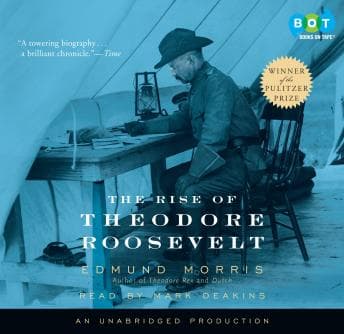

Twenty-six hours is a commitment. That's roughly the same amount of time I spend each semester trying to convince juniors that The Great Gatsby isn't just about a rich guy throwing parties. So when I tell you I listened to every minute of Edmund Morris's The Rise of Theodore Roosevelt and wanted more, you should understand what I'm saying.
I started this during my morning walks along the lakefront with Denise. By week two, I was finding excuses to walk longer routes. By week three, I was genuinely disappointed when we got home.
The Man Behind the Myth
Here's what I didn't expect: I thought I knew Theodore Roosevelt. We all think we know him—the Rough Riders, the big stick, the mustache, the manic energy. But Morris does something remarkable here. He takes the mythology and peels it back, layer by layer, until you're looking at a sickly asthmatic boy in New York who rebuilt himself through sheer, almost terrifying force of will.
This is why we still read—or listen to—the classics. Morris won the Pulitzer for this, and you feel that weight on every page. The research is meticulous but never dry. He writes the way the best historians write: like novelists who happen to be telling the truth. The prose deserves to be savored, which is why I kept my playback at 1.0x even when I was dying to know what happened next.
And look, I teach literature. I've read my share of biographies. Most of them feel like Wikipedia entries with better sentence structure. Too Much and Never Enough had that same problem—fascinating subject, but the writing never quite escaped the feeling of an extended op-ed. Morris writes with the narrative drive of fiction. Roosevelt's transformation from frail child to Harvard boxer to Dakota rancher to police commissioner reads like a novel because Morris understands that great lives have narrative arcs. He's not just documenting; he's interpreting.
Mark Deakins Gets It
Deakins has this rich, warm voice that somehow manages to be both authoritative and intimate. He doesn't just read the text—he performs it. There's a difference, and if you've listened to enough audiobooks, you know exactly what I mean.
Here's where it gets interesting, though. Roosevelt apparently had this high-pitched, almost squeaky voice in real life—nothing like the booming presence we imagine. Deakins has to navigate between historical accuracy and what listeners expect, and occasionally you can feel him wrestling with that. It's a minor thing. Most listeners won't notice. But I'm an English teacher; I notice everything. (Don't tell my students I said that. They already think I'm insufferable.)
What Deakins absolutely nails is the pacing. Twenty-six hours could drag. It doesn't. He knows when to slow down for the emotional beats—Roosevelt's first wife dying on the same day as his mother, for instance—and when to push forward through the political maneuvering. The man understands that pause is punctuation.
Why This Still Matters
I kept thinking about my students while listening to this. Not because they'd love it—honestly, most of them would check out after hour three—but because Roosevelt's story is essentially about self-creation. About deciding who you want to be and then becoming that person through relentless, almost obsessive effort.
That's a message that never gets old. Heartland explores a different kind of self-creation—the kind where you're fighting against economic systems rather than asthma and grief—but the core struggle feels similar. Morris delivers it without ever being preachy. He just shows you the work, the failures, the grief, the reinvention. The interpretation is yours to make.
Who Should Saddle Up (And Who Should Skip)
If you love narrative history that reads like fiction, this is your book. If you're fascinated by how people remake themselves against impossible odds, you'll find Roosevelt's story compelling. Skip it if you need your biographies under ten hours or if political maneuvering makes your eyes glaze over—there's plenty of that here, even if Morris makes it more interesting than it has any right to be.
Class Dismissed
This is the first book in a trilogy, and I'm already planning when to start the second. That's the highest compliment I can give. Worth pausing the faculty meeting for—and I did, multiple times. Principal Martinez, if you're reading this, I was definitely paying attention during your budget presentation. (I wasn't. I was in the Badlands with Theodore Roosevelt, and I regret nothing.)








![Steve Jobs [unabridged audiobook] audiobook cover](/_next/image?url=https%3A%2F%2Fcovers.audiobooks.com%2Fimages%2Fcovers%2Ffull%2F9788499923406.jpg&w=1920&q=75)