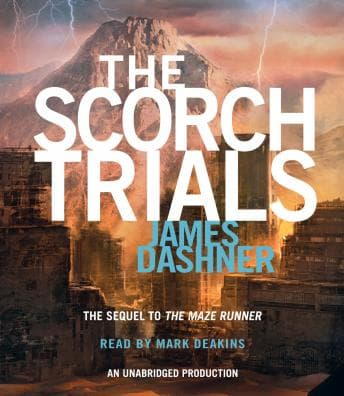

Look, I have a confession. I started this audiobook on a morning jog through Cambridge and ended up standing frozen on the sidewalk near Harvard Square like a complete weirdo because Thomas was about to get his face melted off by a Crank. My therapist would have thoughts about my inability to multitask during high-stress fictional scenarios.
So here's the thing about The Scorch Trials - it's basically a case study in what happens when you strip away every safety net from a group of traumatized teenagers and watch them spiral. And I mean that as a compliment? Dashner understands something fundamental about group psychology under pressure: alliances fracture, paranoia becomes rational, and the kid you'd die for yesterday becomes the variable you can't trust today. The protagonist exhibits classic hypervigilance patterns that actually track for someone who just escaped a murder maze. Points for psychological accuracy.
Mark Deakins. Let's talk about Mark Deakins. The man does accents for Minho and Newt that made me forget I was listening to one person. His Newt has this soft British edge that hits different when things get emotionally intense (and they do, frequently). Deakins carries that same vocal precision to Rogue Lawyer, though there he's navigating courtroom tension instead of post-apocalyptic chaos. He softens for Teresa in a way that captures her weird position as both ally and question mark. Where he really shines is the emotional delivery - there's this moment where Thomas is processing yet another betrayal and Deakins doesn't oversell it. He just... lets it land. That restraint? Chef's kiss.
Now. The pacing criticism. I get it. Some listeners noted the narration feels slightly off during the high-action sequences, and honestly, I noticed it too. There are scenes where you're running for your life from lightning storms and zombie-adjacent infected humans, and the narration maintains this measured quality that doesn't quite match the chaos on the page. It's not bad, exactly. It's just... controlled when maybe it should be breathless. I found myself speeding up to 1.25x during those sections, which helped.
What makes this character study compelling is watching Thomas try to hold onto his moral compass while WICKED keeps moving the goalposts. (Don't even get me started on WICKED. Organizations claiming to act 'for the greater good' are psychologically fascinating and also terrifying.) Thomas wants to be the hero. He wants to save everyone. But Dashner keeps putting him in situations where saving everyone isn't an option, and watching him recalibrate his ethics in real-time is genuinely interesting behavioral territory.
The love triangle stuff? Meh. I found myself asking: why does Teresa really need to be positioned this way? The manipulation dynamics here actually parallel some of what I found in Art of Seduction - that same calculated positioning of emotional leverage that feels more strategic than organic. It feels shoehorned, like someone said 'YA dystopia needs romance tension' and Dashner went 'fine, but I'm not happy about it.' The psychological inconsistency of Teresa's behavior bothered me more than it probably should. People don't just flip like that without better groundwork. This doesn't track as cleanly as the rest of the character work.
But here's where I'll defend this book: the Cranks are genuinely unsettling. The slow deterioration from human to something else, the way some of them are aware enough to know what's happening to them - that's horror rooted in real fears about cognitive decline and loss of self. We fear losing our minds more than losing our lives. Dashner gets that.
The production quality is clean. No weird audio artifacts, no volume issues during my jog (and I was dodging tourists near the river, so I would've noticed). Ten hours is a solid length for a commute listen - I got through it in about a week of morning runs and evening cooking sessions. (Made my mother's dal recipe while listening to teenagers fight for survival in a post-apocalyptic wasteland. Weird juxtaposition, but the dal turned out great.)
Who Should Listen (And Who Should Skip)
If you loved the first Maze Runner, you're already here. If you're into YA dystopia with actual stakes - not the sanitized kind where everyone important survives - this delivers. Fans of Hunger Games and Divergent will feel at home. Commuters, this is your jam. But if love triangles make you want to throw your phone, be warned. And if you need your narration to match the frenetic energy of the action scenes beat for beat, you might find Deakins' measured approach frustrating. Fair warning: this ends on a cliffhanger that made me immediately download book three.
Case Closed
Mark Deakins elevates material that could've been generic YA survival fare into something genuinely engaging. The character voices alone are worth the listen. The story has its weak spots - the romance elements feel forced, some plot mechanics are conveniently vague - but the core psychological tension holds. Thomas is a protagonist worth following, even when he makes choices that made me mutter 'oh no, honey, no' out loud on the street.
My therapist would probably say something about my investment in fictional teenagers' survival odds. But that's between me and her.