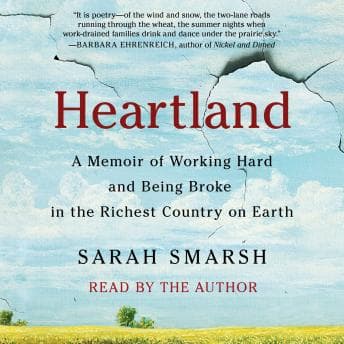

I was sketching a logo for a local coffee shop when Sarah Smarsh started talking about her grandmother's hands. The calluses. The way they never stopped moving. And I just—I had to put my stylus down. Frida jumped on my desk like she knew something was happening, and honestly? She was right.
This book wrecked me in ways I wasn't prepared for.
The Voice That Knows These Stories From the Inside
Look, there's something different about an author reading their own memoir. Sometimes it's awkward—you can tell they're not performers, and the delivery feels stiff. But Sarah Smarsh? She reads this like she's sitting across from you at a kitchen table, coffee getting cold because neither of you can stop talking about family and money and all the things we're not supposed to say out loud.
Her voice has this Kansas flatness to it that's actually perfect for the material. It's not dramatic. It's not trying to make you cry. She's just... telling you what happened. And somehow that restraint makes it hit harder? Like when she talks about her mom's teenage pregnancies, or the way poverty gets passed down like eye color, she doesn't add emotional weight to it. The weight is already there. She trusts you to feel it.
I kept thinking about my abuela while listening. Different circumstances, different geography, but that same thing—women working themselves raw and never having enough to show for it. Abuela would have loved this one. She would have nodded through the whole thing, saying "mija, that's how it was."
Where the Narrative Shifts
Smarsh does this thing where she writes the book to her unborn daughter—a child she chose not to have specifically because she refused to continue the cycle of teen motherhood in her family. It's such a gutsy structural choice. At first I wasn't sure about it, but by hour three I was fully in. It gives the whole memoir this feeling of speaking across time, of breaking a pattern by naming it.
The Kansas wheat farm stuff is beautiful. The descriptions of land and sky and the particular kind of freedom that comes from space—I could see it all. But it's not romanticized. She shows you the beauty AND the way that same land can trap you. The economic forces pressing down on family farms. The way her dad's hands looked like her grandmother's hands, worn down by the same work that wasn't paying enough.
Some memoirs about poverty feel like they're asking for your pity or your admiration. This one doesn't want either. Smarsh is just asking you to see clearly. To understand that "working class" doesn't mean what politicians pretend it means. That these are people with intelligence and humor and dreams who got dealt a different hand.
I ugly-cried at the section about healthcare—or the lack of it. The untreated conditions. The way her family just... lived with pain because what else could they do? My heart. MY HEART.
The Comparison That Keeps Coming Up
People compare this to Hillbilly Elegy a lot, and I get why—both are about rural poverty, both are memoirs. But honestly, they feel really different to me. Smarsh isn't interested in pulling herself up and out and then looking back. She's not telling a bootstrap story. She's questioning the whole system that makes us think bootstraps are the answer. It's the same clear-eyed honesty I found in Promised Land, where the personal never gets separated from the political.
It's more like—okay, you know how Educated by Tara Westover makes you understand a specific family's dysfunction? Heartland does that but zooms out further. It's personal AND political without ever feeling preachy. Smarsh was a journalist before this, and you can tell. She knows how to give you data without it feeling like homework.
The vibes are immaculate if you're in the mood for something that makes you think and feel at the same time. That balance between head and heart—it's what makes Art & Fear work so well too, though obviously in a completely different context. This is a rainy Sunday book. This is a "cancel your afternoon plans" book.
Would I Listen Again?
Yes. But not soon. I need to recover.
Who should listen: If you want to understand something true about this country—about the gap between what we promise people and what we actually give them—this is essential. Anyone who loved Educated or wants memoir that's both personal and political will be all in.
Who should skip: If you're looking for pure entertainment or escape, this isn't that. It's heavy. It's real. There are sections about abusive relationships and economic desperation that sat in my chest for days.
Smarsh doesn't let anyone off the hook, including herself. And her reading it? It's the only way to experience this. That Kansas voice. That matter-of-fact delivery that somehow contains so much love.
I listened at my usual 1.0x and I'm glad I did. You need to sit with this one. Let it breathe.
Frida and Diego both fell asleep on my lap during the last hour. Even they knew we were in something important.









