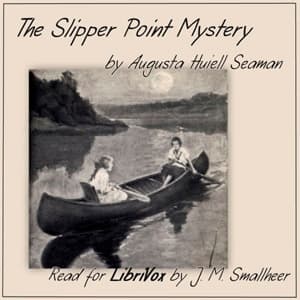

Sophie was doing that thing where she falls asleep in the car seat approximately 90 seconds before we pull into the driveway, which means I have exactly two choices: wake the beast or sit in the driveway and pray. I chose pray. And that's how I ended up listening to a children's mystery from 1919 while my two-year-old drooled on her dinosaur lovey.
Here's the thing about The Slipper Point Mystery - it's three hours and fourteen minutes long. Three hours. That's practically a pamphlet in audiobook terms. I started it on a Monday and finished it by Wednesday, which in my world is basically speed-reading. High praise.
Two Girls, One Secret, and Zero Cell Phones
The setup is simple enough that my interrupted-every-four-minutes brain could track it: Sally Carter, fourteen years old, finds something mysterious at a place called Slipper Point and decides to loop in her new friend Doris Craig. What follows is the kind of mystery that doesn't involve anyone getting murdered or any dark twists that would haunt me at 2 AM. It's two girls being curious and resourceful, poking around a coastal setting, unraveling a puzzle that feels appropriately sized for the story. The coastal atmosphere actually reminded me of Ross Poldark, which does something similar with a windswept, salt-air setting - though Poldark is decidedly not a children's book and considerably darker, so maybe don't queue that one up right after this.
And look, this was published in 1919. You can feel it. The language is formal in a way that kids' books just aren't anymore - Sally and Doris speak like they've been coached in elocution. Nobody says "like" or "literally." The pacing is gentler than what we're used to. It's not slow exactly, but it moves at the speed of girls walking to a point on the shore, not girls frantically texting clues to each other. There's something genuinely charming about that if you let yourself settle into it. It's like reading your grandmother's diary - a little quaint, a little stiff, but weirdly soothing.
I will say the mystery itself is pretty straightforward. Augusta Huiell Seaman wrote over 40 of these books for kids, and you can tell she knew her audience. The clues aren't buried under layers of misdirection. I figured out the general direction of things before Sally did, but I also wasn't mad about it. Not every mystery needs to be Gone Girl. Sometimes you just want to watch smart kids figure something out.
J.M. Smallheer Does the Heavy Lifting
So here's where I have to be honest - there isn't a ton of information out there about this narrator, and this feels like it might be a LibriVox or volunteer recording situation given the public domain nature of the book. Smallheer reads it straight, no dramatic vocal pyrotechnics, no wildly distinct character voices. It's more like a competent read-aloud than a performance, if that makes sense. Think librarian-at-story-time energy rather than full-cast-production energy.
That said? For a 1919 children's mystery, it works. The narration is clear and steady, which is honestly all I needed. I wasn't straining to understand words or rewinding because someone mumbled through dialogue. At 1.25x it moved along at a nice clip. The production is clean - no weird background noise or jarring edits that I noticed.
But if you're someone who needs a narrator to really perform, to give you different voices and emotional range and vocal texture - temper your expectations. This is functional narration. It gets the job done.
Would Emma Actually Like This?
This is the question I kept coming back to. My seven-year-old is right at the edge of the target audience for this book, and honestly? Maybe. The mystery elements would grab her. Two girls being brave and independent and solving a puzzle without adults hovering - that's her jam. But the 1919 language might lose her. Words and sentence structures that feel charmingly old-fashioned to me might just feel confusing to a kid who thinks "yeet" is a verb.
I could see this being a sweet read-along for a parent and an older kid, where you can stop and explain the occasional archaic phrase. Or for a kid who's already a big reader and loves historical settings. But as a standalone audiobook for a modern seven-year-old to listen to independently? That's a harder sell.
For me, an adult who was mostly looking for something light and short and impossible to lose track of between toddler interruptions - it was kind of perfect. Not life-changing. Not something I'll be thinking about in six months. But a pleasant little story that fit neatly into the cracks of my week.
The Car-Time Ruling
Car time approved, but with a caveat. This is the literary equivalent of a cup of chamomile tea - warm, mild, slightly old-fashioned, and nobody's going to write home about it. If you're a mom like me who sometimes just needs something playing in your ears that isn't Cocomelon or the sound of siblings arguing, and you want it done in under four hours? This'll do. I finished this during nap time. High praise. Not groundbreaking, but sometimes you don't need groundbreaking. You just need three quiet hours with two fictional girls who have their act together way more than your actual children do.