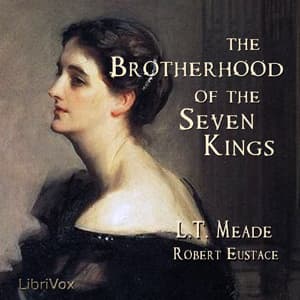

Look, I have a complaint. Why didn't anyone tell me about L.T. Meade before now? I've been listening to thrillers for decades—through sandstorms in Kuwait, on red-eye flights across the Atlantic, during countless hours of Austin traffic—and somehow a Victorian-era female criminal mastermind slipped past my radar entirely. That's an intelligence failure on my part.
Madame Dolorosa. That's her name. And she runs circles around every male detective in 1890s London while commanding a secret society that makes modern organized crime look like amateur hour. I was cleaning my 1911 at the kitchen table (Ranger sprawled at my feet, per usual) when I realized I'd been sitting there for two hours, completely absorbed in schemes involving poisoned gloves and rigged scientific equipment.
When Your Enemy Has Better Intel
Here's what got me: the Brotherhood of the Seven Kings operates like a proper military unit. Compartmentalized cells. Need-to-know information. Plausible deniability built into every operation. Meade wrote this in 1899, but the tradecraft feels disturbingly modern. The society uses cutting-edge science of the era—weaponized bacteria and electrical devices—as their primary tools of coercion and assassination.
I've read plenty of period thrillers where the "secret society" is just window dressing. Not here. The Brotherhood's methods are specific and methodical. Each story in this connected series presents a new scheme, and Norman Head (our detective protagonist) is always playing catch-up. Frustrating in the best way—like watching a chess match where one player is perpetually three moves behind.
Smallheer's narration keeps pace with the plotting. Nothing flashy, no dramatic vocal gymnastics, just clean delivery that lets the Victorian prose breathe without feeling stuffy. At 1.25x, the pacing hit that sweet spot where I could follow the schemes without losing the period atmosphere.
The Woman Problem (In the Best Possible Way)
Madame Dolorosa is the reason to listen to this. Full stop. She's educated, cultured, speaks multiple languages, and runs her criminal empire with the efficiency of a Fortune 500 CEO. In 1899. Written by a woman (Meade was apparently quite popular in her day, though history seems to have forgotten her).
What strikes me—and I say this as someone who's worked with some genuinely dangerous people—is how Meade captures the specific kind of menace that comes from intelligence rather than brute force. Dolorosa doesn't need to threaten violence. She's already ten steps ahead. Her victims are often complicit in their own downfall, manipulated through their own greed or weakness.
The detective, Norman Head, makes for a solid if somewhat conventional foil. He's competent, methodical, but constantly outmaneuvered. (Reminded me of a few lieutenants I knew—good men who just couldn't think around corners.) The dynamic between hunter and hunted carries the episodic structure, each story building on the last while standing alone.
Where the Mission Gets Complicated
At just under eight hours, this isn't a massive time commitment, but I'll be honest—the Victorian prose can get dense. Some of the scientific explanations (period-accurate though they may be) bog down the action. And because this was originally published as connected short stories, there's repetition in how each tale sets up the Brotherhood's threat. By the fourth or fifth story, you've got the picture.
Smallheer handles the material professionally, though I would've appreciated more distinction between characters. When you've got multiple British gentlemen discussing criminal conspiracies, some vocal variety helps track who's speaking. Not a deal-breaker, but noticeable.
The audio quality itself is clean—this is a LibriVox production, and it's one of the better ones I've encountered. No weird background noise, consistent levels throughout.
Who Should Gear Up (And Who Should Stand Down)
If you're into Sherlock Holmes but wish Moriarty had more page time—and was a woman—this is your mission. Fans of period mysteries who want something beyond the usual drawing-room murders will find plenty to chew on. Chamber operates in a similar space—different era, but the same kind of methodical tension that builds without relying on shootouts. History buffs interested in Victorian-era anxieties about secret societies and "foreign influences" will recognize the cultural context.
Skip this if you need constant action. This is cerebral stuff—schemes within schemes, drawing-room confrontations, slow-building tension rather than explosions. (Linda was right about my usual preferences, but occasionally I can appreciate a different kind of warfare.)
Mission Debrief
Brotherhood of the Seven Kings is a genuine discovery—the kind of overlooked classic that makes you wonder what else you've been missing. Madame Dolorosa deserves to be mentioned alongside the great literary villains, and the fact that she's been largely forgotten is a crime in itself. Smallheer delivers the goods without getting in the way, and at eight hours, it's a reasonable investment for a solid historical thriller.
Ranger approved. He perked up every time Dolorosa appeared. Smart dog.