
Look, I'll be straight with you - I almost passed on this one. Early 1900s detective fiction? Figured it'd be some dusty drawing room mystery where everyone speaks in paragraphs and nothing happens for chapters at a time. I've been burned before by these "classics" that haven't aged well.
I was wrong. Dead wrong.
When Forensics Meant Something Different
Here's what got me hooked: Dr. Thorndyke operates like a proper investigator. None of this "the butler looked suspicious" nonsense. The man uses actual forensic evidence, medical knowledge, logical deduction. R. Austin Freeman was a doctor himself, and it shows. Every piece of evidence Thorndyke examines matters. Every observation leads somewhere.
The case involves John Bellingham, an Egyptologist who vanishes under circumstances that are - and I don't use this word lightly - genuinely mysterious. No body. No clear motive. Just a man who walked into a house and seemingly ceased to exist. The legal complications around his disappearance, the inheritance disputes, the scattered bones showing up in the Thames - it's a puzzle box that Thorndyke methodically takes apart.
Is this a fast-paced thriller? Negative. This is slow-burn detective work. The kind where you're following the investigator's logic step by step, and when things click into place, you feel like you earned it. Reminded me of working intelligence analysis, actually - the satisfaction isn't in the action, it's in watching the picture form from scattered data points.
J.M. Smallheer Knows What She's Doing
The narrator here - J.M. Smallheer - she's the reason this works as an audiobook. Her voice is clear, charming, and she does something I really appreciate: the character voices are distinct enough to follow but not cartoonish. Nothing pulls me out of a story faster than a narrator doing ridiculous accents or over-the-top performances. Smallheer keeps it professional. Each character sounds like a real person, not a caricature.
Her pacing matches the material perfectly. She's not rushing through the technical medical and legal discussions (and there are a fair few of those), but she's not dragging either. I listened at my usual 1.25x and it flowed naturally. Ranger seemed to approve too - he didn't give me that look he gives when a narrator's voice grates.
This is a LibriVox recording, so it's free, and honestly? The production quality is solid. Smallheer also narrated House of a Thousand Candles, another early 1900s mystery where her steady delivery works perfectly with the period material. Clean audio, no weird background noise or volume issues. I've paid for audiobooks with worse production.
The Romance Subplot - A Brief Debrief
Yeah, there's a love story woven in. The young doctor who's Thorndyke's former student falls for Bellingham's niece. It's... fine. Period-appropriate, a bit formal by modern standards, but it doesn't derail the mystery. Freeman uses it to give our narrator a personal stake in solving the case, which works tactically. If you're allergic to any romantic elements, you can tolerate this - it's not the focus.
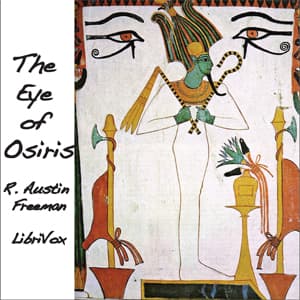
What I appreciated more was the Egyptian archaeology angle. Bellingham was an Egyptologist, and that world - the mummies, the artifacts, the obsessive collectors - creates an atmosphere that's genuinely interesting. The "Eye of Osiris" itself becomes significant in ways I won't spoil, but it's not just window dressing.
Who's This Mission For?
If you appreciate Sherlock Holmes but wish the science made more sense, Thorndyke is your man. If you want forensic investigation that follows logic rather than TV magic, this delivers. Skip it if you need explosions every chapter or can't handle older prose styles.
Here's the debrief: nearly nine hours of methodical, intelligent mystery-solving with excellent narration. If you've got long drives, if you appreciate watching a case come together through actual detective work, if you want something that respects your intelligence - this is solid.
Mission Complete
I've already queued up another Thorndyke mystery. Vanishing Man is next on my list - same author, same methodical approach to forensics. That should tell you something.