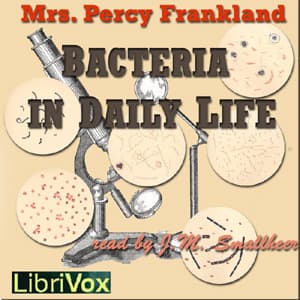

Look, I have a confession. I downloaded this because I was convinced I was getting sick last week - scratchy throat, that weird exhaustion - and my brain decided the rational response was to listen to a 120-year-old book about bacteria while lying awake at 2AM convinced I had tuberculosis. (I did not have tuberculosis. I had allergies and too much cold brew.)
But here's the thing: I couldn't stop listening.
Victorian Science That Actually Holds Up (Mostly)
Grace Coleridge Frankland was doing something genuinely radical in 1903 - taking cutting-edge microbiology research and making it accessible to "the ordinary unscientific person." And she was GOOD at it. This is basically a popular science podcast but for the Edwardian era. She traces the whole history from Latour's discovery that yeast fermentation comes from tiny vegetable growths (her words, not mine) through the major developments of Victorian bacteriology.
The milk chapter is genuinely useful even now - not for the specific recommendations (please do not follow 1903 pasteurization advice), but for understanding WHY we do what we do with food safety. She breaks down contamination vectors, discusses heat treatment, and gets surprisingly technical about bacterial survival rates. Being Mortal does something similar with end-of-life care—taking complex medical realities and making them accessible without dumbing them down. The water purification section reads like a historical foundation for everything we take for granted about municipal water systems.
What actually shocked me: the chapter on how bacteria resist cold. Frankland explains that freezing doesn't kill most bacteria - it just puts them in stasis. I knew this intellectually, but hearing her describe experiments from the 1890s proving this point made me side-eye my freezer with new suspicion.
The Snake Venom Detour Nobody Expected
The final chapter takes a HARD left turn into anti-venom development and I am here for it. Frankland gets genuinely excited describing early experiments with snake venom - how researchers were figuring out that you could build immunity by exposure to gradually increasing doses. It's the most "wait, they figured that out HOW?" section of the book. She's describing what's essentially the foundation of immunology while also casually mentioning researchers injecting themselves with diluted cobra venom. That same "wait, they did WHAT?" energy runs through Isaac Newton—turns out self-experimentation and questionable safety standards were just the vibe for groundbreaking scientists. Victorian scientists were absolutely unhinged and I respect it.
J.M. Smallheer's Steady Hand
The narration is... fine? It's a LibriVox recording, so you're getting volunteer work here, which I always appreciate. Smallheer reads clearly and at a measured pace that works well for the scientific content. No dramatic flourishes, no weird emphasis choices. It's the audio equivalent of a competent lecturer - you won't be blown away, but you also won't be distracted. For a 4h 47m nonfiction listen, that's honestly ideal.
I bumped it to 1.5x without any comprehension issues, which is my standard test for clear narration.
Where It Shows Its Age
I'd be lying if I said this doesn't drag in places. Frankland occasionally gets into the weeds on experimental methodology that was groundbreaking in 1903 but reads as obvious now. And some of her assumptions about "the householder" and domestic responsibilities are... very much of their time. (Lots of advice directed at women managing household hygiene, which - fair for 1903, but definitely noticeable.)
Also, and this is petty, but the chapter on sunshine and bacterial death made me want to throw open every curtain in my apartment. Frankland is VERY enthusiastic about sunlight as a disinfectant. She's not wrong! But I spent the next morning rearranging my home office for better UV exposure like some kind of Victorian wellness influencer.
Debug This Into Your Queue If...
You're the kind of person who reads ingredient labels, wonders why things are the way they are, or just enjoys historical science writing that doesn't talk down to you. Skip if you want entertainment over education, or if historical scientific racism is a hard no (Frankland doesn't engage in the worst of it, but there are some colonial-era assumptions baked in).
The ROI on this audiobook is surprisingly high for something written before antibiotics existed. It's short, it's free (LibriVox), and it'll make you appreciate modern food safety in ways you didn't expect. I finished this in 3 commutes and came away with a genuine appreciation for how much we've built on Victorian bacteriology. Also a slight paranoia about ice. But mostly appreciation.



![Steve Jobs [unabridged audiobook] audiobook cover](/_next/image?url=https%3A%2F%2Fcovers.audiobooks.com%2Fimages%2Fcovers%2Ffull%2F9788499923406.jpg&w=1920&q=75)