
"I will make them pay for every drop of Nikara blood."
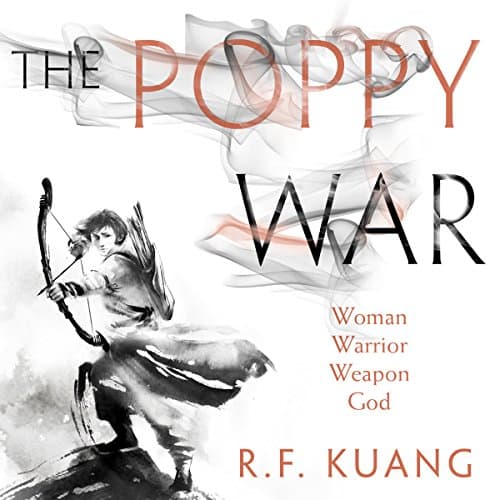
Somewhere around the halfway mark of this nearly nineteen-hour audiobook, that line hit me like a gut punch during my morning commute. I actually sat in my parked car for an extra ten minutes because I couldn't stop listening. The Poppy War had shifted underneath me — what started as a scrappy underdog-gets-into-elite-school story had become something far darker, far angrier, and far more devastating than I was prepared for.
R.F. Kuang's debut draws heavily from twentieth-century Chinese history, particularly the Second Sino-Japanese War and the horrors of the Nanjing Massacre. If you know that history, you'll recognize the bones of this story immediately. If you don't, you're about to get an education wrapped in fantasy that doesn't flinch. The same pull toward uncomfortable historical truth is what drew me to Spy Among Friends: Kim Philby and the Great Betrayal — another work where the real events are so staggering that fiction almost can't compete. The fictional Empire of Nikan, its people, its military academies, and its gods all feel grounded in something real and painful, which gives the worldbuilding a weight that pure invention rarely achieves.
Rin is one of those protagonists you root for even when she terrifies you. She's a war orphan from the impoverished south who claws her way into Sinegard, the empire's most prestigious military academy, through sheer determination — and by literally burning herself with substances to stay awake while studying. That tenacity never leaves her, but what it transforms into over the course of the book is the real story. Kuang doesn't write a hero's journey so much as a hero's unraveling, and the trajectory from desperate student to something far more dangerous is both earned and heartbreaking.
The first third of the book operates in familiar territory — academy politics, class prejudice, martial arts training, an eccentric teacher who sees potential no one else does. Think of it like rolling a new character in a campaign and spending the first few sessions on backstory and skill checks before the DM drops the apocalypse on you. Comparisons to other school-based fantasy are inevitable, and honestly, fair. Some listeners have noted that this section can feel slow, and the dialogue occasionally lands with a modern, almost young-adult cadence that briefly pulls you out of the ancient setting. I felt that friction a couple of times myself. But Kuang is laying groundwork here, and when the Poppy War actually arrives, every classroom scene, every sparring match, every strange lesson in shamanism pays off with compound interest.
And then the war comes, and the book becomes something else entirely.
I need to be direct about content warnings here: this book depicts genocide, sexual violence, medical experimentation, addiction, and the kind of wartime brutality that will stay with you. Kuang doesn't exploit these elements — they're rooted in historical events — but she doesn't soften them either. There were passages I listened to that left me genuinely shaken. This is not background listening material. This demands your full attention and a certain readiness for darkness.
Now, about Emily Woo Zeller's narration — she's the reason this audiobook earned its AudioFile Earphones Award. Zeller carries Rin through every stage of her arc: the hungry, ambitious girl; the bewildered student; the soldier confronting horrors she can't process; the vessel channeling powers that threaten to consume her. Each version of Rin sounds distinct but connected, like watching someone age in real time through their voice alone. Her supporting cast work is strong too — the teachers, the Cike operatives, the generals all get their own vocal identities without Zeller ever resorting to cartoonish accents or over-the-top characterization.
Where Zeller really earns her keep is in the book's most brutal passages. The war scenes, Rin's descent into opiate addiction, the moments where gods speak through human mouths — Zeller handles all of it with an intensity that never tips into melodrama. The story asks a lot of a narrator. She delivers.
The worldbuilding deserves its own section, because honestly, it's where my nerd brain lit up. Kuang builds a magic system rooted in shamanism and psychoactive substances that feels genuinely different from standard fantasy fare. The gods here aren't benevolent — they're ancient, alien, and hungry. Accessing their power requires surrendering pieces of yourself, and the cost is never abstract. It maps beautifully onto the book's larger themes about what war demands from the people who fight it. Think of it less like a Vancian spell-slot system and more like a warlock pact where the patron actually collects.
If I have a criticism, it's that the tonal shift between the academy first act and the war-torn second half is almost too sharp. The book essentially becomes two different novels stitched together, and while both are excellent, the seam shows. Some readers will love the academy section and feel blindsided by what follows. Others will find the school portion too slow and only engage once the conflict ignites. I'd argue that discomfort is partly the point — Kuang wants you to feel the whiplash of a world that changes overnight — but it's worth knowing going in.
Who Should Listen (And Who Should Skip)
If you love grimdark fantasy with real historical teeth, complex magic systems, and protagonists who make morally devastating choices — this is your next listen. Fans of military fantasy and anyone who appreciates worldbuilding rooted in actual history will find nearly nineteen hours well spent. Skip it if you need lighter fare, can't handle graphic depictions of wartime atrocity, or if a slower academy-focused opening act is a dealbreaker for you.
At nearly nineteen hours, this is a substantial listen. It rewards patience and focused attention. I found it perfect for commutes and dedicated evening sessions, but I wouldn't recommend it for casual or distracted listening. Too much happens between the lines, and Zeller's performance deserves ears that are actually paying attention.
The Poppy War announced R.F. Kuang as a major voice in fantasy, and the audiobook format — with Zeller at the helm — might be the best way to experience it. Just be ready. This one will rearrange what you expect from the genre.