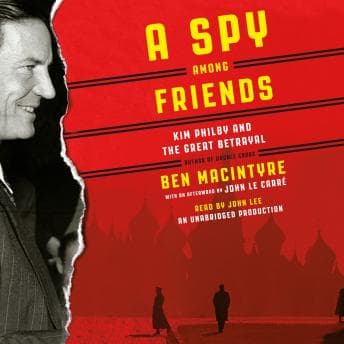

How do you betray your country for thirty years while drinking martinis with the men hunting you?
That question kept me awake last night. Ranger was snoring at the foot of the bed, Linda was asleep, and I'm staring at the ceiling at 0200 trying to figure out Kim Philby. Just finished this one during a long drive back from a client site in Houston - four hours of I-10 with nothing but mesquite and this audiobook for company.
Let me cut to the chase: Ben Macintyre delivers a first-rate piece of espionage history that reads like fiction but hits harder because every word is true. This isn't some Hollywood spy fantasy. This is the real thing - the slow, patient, devastating work of a man who sold out his friends and got hundreds of people killed.
The Anatomy of a Traitor
What got under my skin was the friendship angle. Philby and Nicholas Elliott - these guys were brothers in everything but blood. Cambridge together, MI6 together, drinking together, families vacationing together. Elliott trusted Philby with his career, his secrets, probably his life. And Philby was feeding every word to Moscow.
Macintyre builds this relationship so carefully you almost forget you know how it ends. Then you hit that verbal duel in Beirut, 1963 - Elliott finally confronting his best friend with the evidence - and it's devastating. Not because of violence or explosions. Because of what it costs Elliott to accept what Philby really was. I've seen men lose brothers in combat. This felt worse somehow. At least in war, you know who the enemy is.
The author clearly did his homework. The access to British intelligence files shows, and having John le Carré write the afterword? That's not a gimmick. Le Carré knew these people. Worked in the same world. His perspective adds a layer of authenticity that money can't buy.
John Lee's Measured Approach
John Lee narrates this at a pace that matches the material - deliberate, precise, no rushing through the details. His British accent feels natural for the MI6 crowd, and he shifts to a decent American register when handling James Jesus Angleton and the CIA contingent. The class distinctions come through - you can hear the difference between the Cambridge old boys and the working-class operatives.
Some folks apparently find his delivery a bit stiff in the dialogue sections. I can see that. There's a formality to his approach that occasionally makes conversations feel like they're being read rather than performed. But honestly? For historical nonfiction this dense, I'd rather have measured and clear than dramatic and distracting. Lee keeps you focused on the information, and with material this complex, that's the right call.
I listened at my usual 1.25x and had to dial it back to normal speed a few times. There's a lot of names, a lot of operations, a lot of interconnected betrayals. This isn't background listening material - you need to pay attention.
Where It Lost Me (Briefly)
The middle section drags slightly when Macintyre gets deep into the bureaucratic infighting at MI6. Important context, sure, but there were stretches where I found myself more interested in the oncoming traffic than the internal politics of British intelligence circa 1955. Pacing issues in nonfiction usually mean the author's being thorough at the expense of momentum. That's the case here.
But when it picks back up - and it does - the payoff is worth the slower stretches. The final act, watching Philby's world collapse in slow motion while he maintains that charming facade, is genuinely suspenseful even when you know exactly how it ends.
Who This Is For (And Who Should Skip It)
If you're interested in Cold War history, intelligence operations, or just want to understand how institutions can be so catastrophically blind to threats from within - this is essential. If you've read le Carré's fiction and wondered how close to reality he got, here's your answer: very close.
Skip this if you want action-packed spy thriller pacing. This is history, not Hollywood. The tension is psychological, the betrayals are bureaucratic, and the body count happens offscreen. But that makes it more chilling, not less.
Anyone who's worked in security - military, corporate, government - will recognize the institutional failures here. Extreme Ownership tackles similar institutional blind spots from a different angle - how leaders create cultures where problems get hidden instead of solved. The "he's one of us" mentality that let Philby operate for decades. We still see it. We probably always will.
Ranger's Verdict
Ranger approved this one, though he slept through most of it. Worth your time? Absolutely. Macintyre takes a story that could've been a dry historical account and turns it into something that genuinely disturbs you. Not because of what Philby did - traitors exist, always have - but because of how long good men refused to see it.
Eleven hours well spent. Just don't listen right before bed unless you want to spend the night wondering which of your friends is lying to you.






![Steve Jobs [unabridged audiobook] audiobook cover](/_next/image?url=https%3A%2F%2Fcovers.audiobooks.com%2Fimages%2Fcovers%2Ffull%2F9788499923406.jpg&w=1920&q=75)