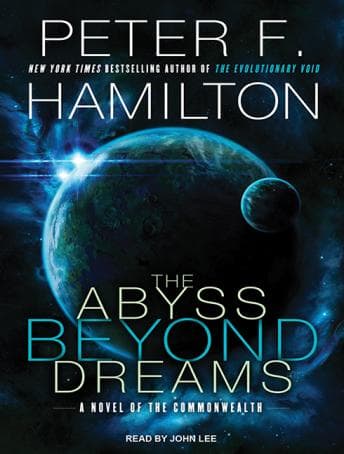

Twenty-two and a half hours. That's what Peter F. Hamilton asks of you before you even get to the second book. My thesis advisor would weep if she knew I spent that much time on anything that wasn't procedural generation algorithms. But here's the thing—I regret nothing. Absolutely nothing.
I started this at 2 AM because I couldn't sleep, brain buzzing from too much caffeine and a D&D session that went sideways (our rogue tried to seduce a dragon, it went poorly). By sunrise, I was still listening, completely forgetting I had a meeting with Dr. Patel. Oops.
The Commonwealth Universe is Basically a Campaign Setting on Steroids
If you've never touched Hamilton's Commonwealth books before, you're walking into a universe built across multiple series spanning thousands of years of fictional history. This is Sanderson-level world-building, except instead of hard magic systems, you get wormhole technology, rejuvenation treatments that make death optional, and a galaxy-threatening cosmic anomaly called the Void that's basically the ultimate BBEG.
Nigel Sheldon—one of the guys who literally invented wormhole technology—gets recruited by the Raiel (ancient alien guardians who've been containing the Void for eons) to infiltrate this cosmic horror at the galaxy's core. And inside? Humans. Trapped for centuries. Developing psychic powers. Fighting an alien species called Fallers that can perfectly mimic people they consume.
My D&D group would lose their minds over this setup. Body-snatching aliens? Psychic abilities that function like a soft magic system? Political intrigue between factions who've been isolated for generations? It's campaign material for days.
John Lee Walked So Space Opera Could Run
John Lee has narrated basically the entire Commonwealth Universe at this point, and there's a reason Hamilton keeps coming back to him. The man builds tension so gradually you don't realize you've been holding your breath until a scene ends. I caught myself actually leaning forward during one of the Faller infiltration sequences—in my desk chair, at 4 AM, like a complete lunatic.
His approach to the massive cast is interesting. Lee doesn't do wildly different voices for every character—instead, he works in subtle register shifts. Nigel sounds measured, almost clinical, befitting a man who's lived for centuries and seen civilizations rise and fall. The Void-trapped humans have this slightly more urgent quality, people who've grown up under constant existential threat. The Fallers—when they're pretending to be human—have this uncanny smoothness that made my skin crawl once I knew what to listen for.
It's not Steven Pacey-level vocal gymnastics (nobody touches that man's Logen Ninefingers), but Lee brings something else: this quality of reverence and awe when describing the cosmic-scale stuff. When the Void's nature gets explained, when the true scope of what Nigel's attempting becomes clear, Lee's delivery makes it feel appropriately vast. You're not just hearing exposition. You're hearing someone describe something genuinely incomprehensible.
The Info-Dump Question (You Know I'm Bringing This Up)
If you don't like info-dumps, this isn't for you. But you're wrong.
Hamilton doesn't apologize for explaining how his technology works, how his societies function, or why his alien species evolved the way they did. The Fallers aren't just creepy body-snatchers—there's biological logic to their existence, tied into the Void's reality-warping nature. The psychic abilities that humans develop inside the Void follow consistent rules. Similar vibes to Rhythm of War in that way—massive scale, detailed systems, and a runtime that demands your attention.
This is the kind of science fiction that rewards attention. I listened at 1.25x during the action sequences and dropped to 1.0x during the worldbuilding sections because I wanted to actually absorb the details. At 22 hours, pacing yourself matters.
Who's Going to Love This (And Who Should Run)
This is for you if: You've read any Commonwealth books and want more. You love space opera with actual science behind the fiction. You think Dune needed more wormhole physics. You have 22 hours and zero regrets about how you spend them.
Skip if: You want a standalone story (this is very much Part One of a duology). You need fast pacing from page one. You haven't read any Commonwealth books and refuse to start with the earlier series.
Honestly, you can start here—Hamilton provides enough context—but you'll miss layers of history that make Nigel's mission feel weighted with centuries of consequence.
Roll for Initiative Against Your TBR List
I finished this at 3 PM on a Tuesday when I should have been writing my thesis chapter on procedural dungeon generation. Instead, I immediately downloaded the sequel. Dr. Patel, if you're reading this, I promise I'm making progress. (I'm not making progress.)
The progression is satisfying, the stakes are cosmic without losing human stakes, and John Lee delivers a performance that justifies every minute of that runtime. Yes, it's 40 hours across both books. Yes, it's worth it. My thesis can wait.