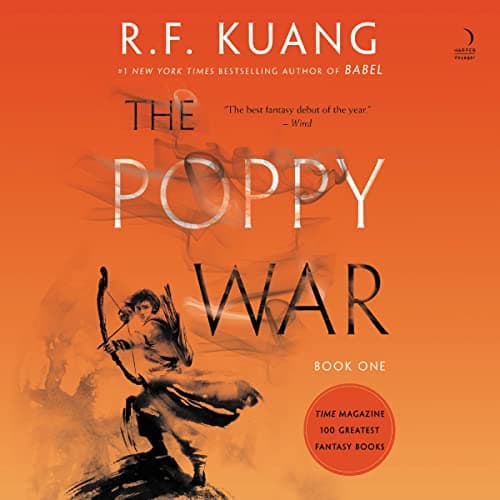

I made the mistake of starting The Poppy War on a long solo drive through rural Pennsylvania, thinking a fantasy audiobook would keep me alert. By hour three, I was white-knuckling the steering wheel — not from drowsiness, but because R.F. Kuang had me so deep in Rin's world that I nearly missed my exit twice. And then the back half of this book hit, and I had to pull into a rest stop just to sit with what I'd heard.
Let me be upfront: The Poppy War is two very different books stitched together, and your enjoyment depends on whether you're prepared for that shift. The first act is essentially a dark academia military school story. Rin, a war orphan from the rural south, claws her way into Sinegard, the empire's most prestigious military academy, and proceeds to fight for every scrap of respect against classmates who despise her for her skin color, poverty, and gender. If you've read any underdog-at-a-magic-school story, some beats will feel familiar. I kept thinking about Siege of Earth, which leans into those same familiar genre beats but never quite finds the courage to make its protagonist genuinely unlikeable the way Kuang does here. But Kuang writes Rin's desperation with a raw, ugly honesty that separates this from your typical chosen-one narrative. Rin doesn't politely persevere — she self-destructs, rages, and makes choices that made me genuinely uncomfortable.
Then the war comes, and the book transforms into something closer to historical horror. Kuang draws directly from the Second Sino-Japanese War and the Rape of Nanjing, and she does not flinch. This is where the content warnings earn their keep — we're talking genocide, medical experimentation, and graphic depictions of wartime atrocity filtered through a fantasy lens. The tonal whiplash is deliberate, and it works, but listeners need to know what they're walking into.
Emily Woo Zeller's narration is the engine that makes nearly twenty hours of this material bearable — and often extraordinary. She brings a focused intensity to Rin that captures both the character's fierce ambition and her slow erosion under the weight of power she can't fully control. The emotional delivery during the war sequences is devastating. Zeller doesn't melodramatize; she lets the horror of the text do its work while grounding every scene in Rin's specific, personal experience of it. The supporting cast comes through clearly too — her portrayal gives each character enough distinction to track without resorting to cartoonish voices.
Now, here's the honest split: some listeners find Zeller's interpretation of Rin grating. I've seen the complaint that Rin comes across as whiny or perpetually aggrieved through Zeller's delivery, and I understand where that's coming from even if I disagree. Rin IS abrasive. She's angry, impulsive, and frequently insufferable in the way that traumatized teenagers actually are. Zeller leans into that authenticity rather than softening it, and for some listeners, nineteen-plus hours of that energy is too much. If you need a likeable protagonist to carry you through a long listen, this will test your patience.
What impressed me most about the audiobook format specifically is how it handles the shamanic magic system. On the page, descriptions of Rin accessing the gods through meditation, drugs, and altered consciousness could read as abstract or confusing. Heard aloud through Zeller's careful pacing, these sequences become almost hypnotic. You feel the pull of the Phoenix god the way Rin does — seductive and terrifying in equal measure.
The worldbuilding deserves its own discussion. Kuang builds a fantasy China — called Nikan — that never feels like a thin reskin. The political structures, ethnic tensions, and military history all carry the weight of real historical research behind them, because they do. This isn't a white author borrowing Asian aesthetics for flavor; it's a Chinese-American writer wrestling with her own cultural history through the framework of epic fantasy. That specificity gives the entire novel a gravity that most debut fantasies can't match.
My chief criticism is pacing. The school portion runs long, and while it establishes crucial character dynamics, there are stretches in the middle where the story plateaus. At 1.25x speed, these sections moved more comfortably without losing any of the emotional texture. The war half, by contrast, is relentless — almost exhaustingly so. The tonal imbalance between the two halves is the book's most significant structural weakness.
But that weakness is also kind of the point. Kuang is showing you what it means when the comfortable world of academic competition gives way to the reality of imperial violence. The discomfort is the design.
Who Should Listen (And Who Should Skip)
If you want grimdark fantasy rooted in real history, with a protagonist who earns nothing easily and a narrator who commits fully to that roughness — this is your listen. Skip it if you need a sympathetic lead to stay engaged, or if graphic depictions of wartime violence are a hard boundary for you.
This is a remarkable debut novel and an excellent audiobook production. It won the AudioFile Earphones Award in 2018 for good reason. Zeller's performance elevates already strong material into something that lodges in your brain and doesn't leave. I finished it sitting in my car in a Sheetz parking lot at dusk, engine off, staring at nothing. That's the kind of audiobook this is.