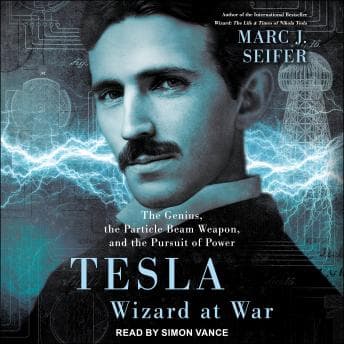

What does it mean to be a genius who dies broke, alone, and convinced that governments are stealing your ideas - while also being completely right?
I started this one on a Saturday lakefront walk with Denise, which turned out to be a mistake. Not because it's bad - because I kept stopping to tell her things. "Did you know Tesla was negotiating with Stalin?" She was very patient. She's had twenty years of practice. That kind of "stop everything, listen to this" quality is rare - I had it once before with First Ladies, which pulled me into corners of American history I had no idea I was missing.
Seifer has spent four decades on Tesla, and that depth shows - sometimes gloriously, sometimes exhaustingly. This isn't a cradle-to-grave biography. It's a focused excavation of Tesla's final decades: the particle beam weapon he called the "teleforce," the Wardenclyffe tower (whose real purpose, Seifer argues, was never quite what we thought), and the increasingly desperate diplomatic maneuvering of a man who believed he could end war by making it unwinnable for everyone. The 1925 quote that opens the book - Tesla essentially describing mutually assured destruction forty years before the Cold War made it doctrine - stopped me cold on the lakefront path. I had to rewind it. That's not me being slow. That's the kind of thing that deserves a second hearing.
The Death Ray Is Less Dramatic Than You'd Hope, And More Interesting
Here's what I didn't expect: the particle beam weapon sections aren't really about the weapon. They're about what it reveals - a man trying to convert scientific credibility into geopolitical leverage, pitching his "death ray" to the U.S. government, to Canada's General McNaughton, and yes, to Stalin's Soviet Union, all while the patents and papers kept disappearing under suspicious circumstances. Seifer connects this directly to the origins of what Reagan would later call Star Wars technology, and that throughline from Tesla's 1930s proposals to Cold War missile defense is genuinely startling once you see it laid out.
The repetition problem other listeners mention is real. Seifer circles back to certain arguments - particularly around Wardenclyffe's true purpose and the FBI's interest in Tesla's papers - multiple times, in ways that feel less like reinforcement and more like the manuscript needed a stricter editor. I caught myself drifting during faculty meeting hours (sorry, Principal Martinez) and having to rewind. At 13 hours, this could've been 10 hours without losing the argument.
Simon Vance Earns His Keep
Vance's Oxbridge precision is exactly right for this material. Tesla was, by all accounts, a man of formal, almost theatrical speech - a European intellectual performing American ambition - and Vance's precise diction captures that register without making it feel stuffy. When he reads Tesla's own letters and statements, there's a quality to the delivery that makes you feel the weight of a man who knew he was writing for posterity. No gimmicks. No affected "mad scientist" energy. Just a narrator who understands that sometimes the most dramatic choice is restraint.
I listened at 1.0x, as God and the author intended. Some of the technical passages on Tesla's dynamic theory of gravity genuinely require it. My students would call this "extra." They would not be entirely wrong.
Who This Is Actually For
If you've never read anything about Tesla, start somewhere else - Seifer's own earlier book Wizard is apparently the right foundation, and jumping into this one cold is like starting Middlemarch at Book Three. You'll follow the plot but miss the architecture.
If you already know the broad strokes - the AC current wars with Edison, the Wardenclyffe disaster, the pigeon - this is where it gets genuinely strange and underexplored. The diplomatic Tesla, the weapons-negotiating Tesla, the Tesla who understood the Cold War before anyone had a name for it. That's the book here, and it's worth the repetitive stretches to find it.
This is why we still read - and listen to - the classics of intellectual biography. Not for the comforting narrative of misunderstood genius, but for the uncomfortable question underneath it: what do we do with a mind that's right about everything except how power actually works?








![Steve Jobs [unabridged audiobook] audiobook cover](/_next/image?url=https%3A%2F%2Fcovers.audiobooks.com%2Fimages%2Fcovers%2Ffull%2F9788499923406.jpg&w=1920&q=75)