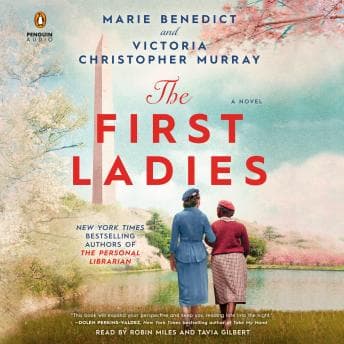

I'm going to start with a complaint. Fourteen and a half hours is a serious commitment, and around hour eight - somewhere in the middle of yet another cabinet meeting - I found myself wondering if Benedict and Murray trusted their readers enough to let the friendship speak for itself without quite so much political scaffolding.
But then Mary McLeod Bethune would open her mouth, and Robin Miles would deliver a line with such quiet dignity that I'd forget I was grading a stack of essays on The Great Gatsby at 11 PM. And I'd think: okay. Okay, this is why we're here.
Two Voices, Two Americas
The dual narration here isn't gimmick - it's architecture. Tavia Gilbert gives Eleanor Roosevelt this slightly high, clipped cadence that sounds exactly like those old newsreel recordings. You know the voice. That patrician uncertainty, the woman who was born into privilege but never quite comfortable in her own skin. Meanwhile, Robin Miles narrates Mary's chapters with a warmth and steel that reminded me of listening to Beloved years ago. The contrast isn't subtle, and it shouldn't be. These women came from different Americas, and the audiobook makes you feel that distance in every syllable. That kind of structural storytelling—where form mirrors theme—is something I also loved about Memoirs of a Geisha, though there it's one woman navigating multiple worlds rather than two women in parallel.
The alternating chapter structure means you're constantly code-switching between worlds. One moment you're in the White House, navigating FDR's infidelity and Eleanor's growing independence. The next you're watching Mary build Bethune-Cookman College from nothing while white supremacists literally try to burn it down. The narrators hand off the story like relay runners, and there's something powerful about hearing these parallel lives in two distinct voices rather than one narrator trying to contain multitudes.
The Personal Librarian's Spiritual Successor
If you loved The Personal Librarian - Benedict and Murray's previous collaboration, also narrated by this same duo - you'll recognize the formula. Take a remarkable woman history has undervalued. Pair her with another remarkable woman. Let their friendship illuminate both the possibilities and limitations of their era. It works because the formula isn't really a formula; it's a thesis about how change happens. Not through lone heroes, but through unlikely alliances.
The difference here is scope. The Personal Librarian was intimate, focused. First Ladies sprawls across decades, wars, movements. Sometimes that ambition serves the story - you really feel the weight of what these women accomplished together. Sometimes it buries the emotional core under historical exposition. (My students would call this "too much context." They're wrong about a lot of things, but they're not entirely wrong about this.)
Where the Prose Earns Its Fourteen Hours
The discovery of FDR's affair with Lucy Mercer - the way the novel handles Eleanor's devastation and subsequent transformation - this is where the writing justifies its length. Gilbert's narration gets quieter in these sections, more controlled, and you hear Eleanor rebuilding herself word by word. I listened at 1.0x, obviously, because the author chose those words and I choose to hear them properly.
Mary's sections have a different energy. More urgency, more danger. There's a particular quality to how Miles voices Mary's internal monologue during confrontations with segregationists - this measured patience that barely contains fury. It reminded me of what Baldwin said about being Black in America: the constant negotiation between what you feel and what you can afford to show.
Worth Pausing the Faculty Meeting For
Here's what I kept thinking about during Principal Martinez's budget presentation (sorry, Principal Martinez): this is a story about how two women decided their friendship was more important than their comfort. Eleanor took real political risks for Mary. Mary pushed Eleanor past her patrician limitations. Neither woman was perfect - the novel doesn't pretend otherwise - but their partnership helped lay groundwork for the civil rights movement.
That's not small. That's not just "inspiring historical fiction." That's a template for how change actually happens.
Who Should Listen (And Who Should Maybe Wait)
If you want a quick, propulsive listen - this isn't it. The pacing drags in places, particularly through some of the New Deal policy sections. If you're looking for something to half-listen to while doing dishes, you'll miss too much. But if you're the kind of listener who wants to understand how we got here - how the early 20th century's impossible alliances created cracks in systems that seemed permanent - this is worth your time. Dedicated listening. Maybe a long road trip with someone who doesn't mind you saying "wait, listen to this part" every thirty minutes.
The Assignment I'd Give
If I were teaching this - and honestly, I'm considering it for my AP class - I'd ask students to track the moments where Eleanor and Mary's worldviews collide. Where privilege meets reality. Where good intentions aren't enough. The novel doesn't shy away from those tensions, and Miles and Gilbert voice them with the complexity they deserve.
This is why we still read the classics. And why we need new stories that help us see the classics - and ourselves - more clearly.