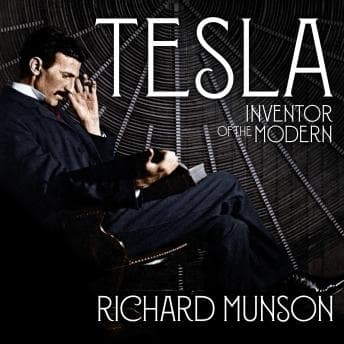
How does a man who invented the 20th century die broke, feeding pigeons in a New York park?
I was on a red-eye to Chicago, prepping for a client meeting about—ironically—clean energy infrastructure, when I finished this one. Nine hours of Tesla's life, and I kept thinking about my dad. Not because my dad was a genius inventor, but because Tesla had the same fatal flaw as every brilliant immigrant I've watched struggle: he trusted handshakes over contracts.
The Business Case Study Nobody Wanted
Here's what Munson gets right. Tesla wasn't just an eccentric genius—he was a case study in how not to monetize innovation. The man invented alternating current, the radio (yes, before Marconi—the Supreme Court confirmed this in 1943), the induction motor, remote control, neon lamps. He literally electrified the world. And he died with nothing because he tore up a royalty contract with Westinghouse that would've made him one of the wealthiest men in history.
Munson, who runs clean energy efforts at the Environmental Defense Fund, brings an operator's perspective to this. He understands why Tesla's AC system beat Edison's DC empire—it wasn't just better science, it was better economics. You could transmit power hundreds of miles without building a generator every two blocks. This is what my parents did instinctively—find the solution that scales. Tesla found it. He just couldn't close.
Charles Constant Earns His Keep
The narrator grounds what could've been a hagiography. Constant has this clear, measured delivery that works perfectly for Tesla's personality—controlled, precise, slightly detached from normal human emotion. When he describes Tesla requiring exactly nine napkins at every meal, or refusing to shake hands, or eating only white food in his later years, there's no mockery in the voice. Just observation. It's the right call. Tesla was strange, but his strangeness wasn't the point.
Constant also handles the technical sections without making them feel like a physics lecture. The explanation of how alternating current actually works—the rotating magnetic fields, the phase differences—it's genuinely educational without being condescending. I've sat through McKinsey presentations that couldn't manage that balance.
Where It Gets Bogged Down
Nine hours is a lot of Tesla. And Munson occasionally gets lost in minutiae that doesn't serve the larger narrative. Do I need to know every detail of every patent battle? Some of them, sure. All of them? My 2.0x speed couldn't save some of these sections.
There's also a research accuracy question that some listeners have raised. I'm not a Tesla scholar, so I can't verify every claim. But Munson's perspective as a clean energy advocate sometimes feels like it's shaping which details get emphasized. That's not necessarily bad—everyone has a lens—but it's worth knowing going in. If you want the definitive academic treatment, apparently W. Bernard Carlson's biography is the one. This is the accessible one.
The Real Tragedy
What hit me hardest was the JP Morgan section. Tesla had a vision for wireless power transmission—free energy broadcast like radio waves. Morgan funded the Wardenclyffe Tower project, then pulled out when he realized Tesla wanted to give the power away. "Where do I put the meter?" Morgan supposedly asked. And that was it. The tower got demolished for scrap.
I've seen this play out at three different companies. The visionary who can't explain the business model. The investor who only sees the meter. The technology that dies because nobody figured out the go-to-market. Tesla's story is a hundred years old and it's happening in every venture-backed startup right now.
Jenny would say I'm being harsh. Jenny is right. Tesla deserved better partners. But he also needed to learn that genius doesn't protect you from getting screwed. Alexander Hamilton understood this instinctively—he built systems that outlasted him because he knew how to navigate power, not just wield it.
Who Gets Value Here (And Who Doesn't)
Engineers who want to understand the man behind the unit of magnetic flux density. Business people who need a cautionary tale about intellectual property. Anyone who saw The Current War and felt like Tesla got shortchanged—this book is the corrective. Skip if you want a quick overview; this is comprehensive, sometimes exhaustingly so.
The ROI Assessment
Worth the credit if you're genuinely interested in the intersection of innovation and commerce. The key insight alone justifies the listen—that technical brilliance without business acumen is just expensive philanthropy. Open Book explores a different kind of genius-meets-commerce story, though Jessica Simpson's version involves fewer patents and more retail strategy. The other 7 hours? Mostly worth it, with some skippable sections in the middle patent wars. Skip to chapter 5 if the early biographical stuff drags. Thank me later.
Tesla died alone in a hotel room. The FBI seized his papers. His name is now on electric cars he had nothing to do with. There's a lesson there about legacy and branding that Munson doesn't quite articulate, but you'll feel it anyway.




![Steve Jobs [unabridged audiobook] audiobook cover](/_next/image?url=https%3A%2F%2Fcovers.audiobooks.com%2Fimages%2Fcovers%2Ffull%2F9788499923406.jpg&w=1920&q=75)