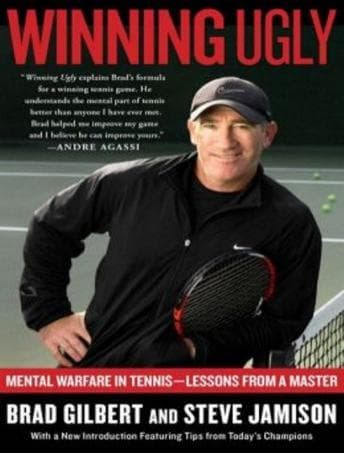

I was grading essays on The Great Gatsby at 11 PM—thirty-seven papers deep, red pen bleeding dry—when I needed something to keep me awake that wasn't another student explaining that the green light represents "like, hope or whatever." So I put on a tennis book. A tactical tennis book. About a guy whose whole philosophy is winning without being pretty.
The irony hit me around hour two. Here I am, spending my career teaching students to appreciate beautiful prose, and Brad Gilbert is out here arguing that ugly wins. That substance beats style. That the player who thinks clearly beats the player who swings beautifully.
My students would hate this. I love it.
The Anti-Hemingway of Tennis
Gilbert's central thesis reminded me of what Hemingway said about writing—that the iceberg's power is what's beneath the surface. Except Gilbert flips it. He's saying forget the iceberg metaphor entirely. Just win the point. Play the percentages. Make your opponent uncomfortable.
The book breaks down into tactical chunks that feel almost academic in their precision. The "Seven Hidden Ad Points" section is particularly sharp—Gilbert identifies specific moments in a match where the psychological weight of a point exceeds its scoreboard value. It's game theory applied to baseline rallies. The kind of systematic thinking I try to get my juniors to apply to literary analysis. (They don't. They really don't.)
What struck me most was Gilbert's advice to never serve first. Six reasons. Counterintuitive, backed by logic. This reminds me of teaching students to avoid the obvious thesis—the first idea isn't always the strongest position. Sometimes you let your opponent commit first.
Charles Constant Knows His Assignment
The narration here is workmanlike in the best sense. Constant reads with a commanding clarity that matches the material—no dramatic flourishes, no attempts to make tactical advice sound like poetry. He understands that pause is punctuation, and he deploys it when Gilbert's strategies need a moment to land.
There's a reliability to his delivery that one reviewer compared to "the repetitive thumps of a tennis ball volleyed in a big match." That's exactly right. Constant isn't trying to entertain you. He's trying to teach you. The voice stays out of its own way, which is precisely what instructional audio needs.
No music. No sound effects. Just a clear voice delivering clear information. Worth pausing the faculty meeting for—though I'll admit I was listening during Principal Martinez's quarterly budget review. (The district is cutting arts funding again. Gilbert would probably have a strategy for that too.)
Why This Works for Non-Tennis Players
Here's the thing—I play tennis maybe twice a year, badly, with Denise's brother who always wins. But Gilbert's framework transcends the sport. The sections on handling "psyching and gamesmanship" read like classroom management advice. How to maintain composure when someone's trying to throw you off. How to recognize when you're being manipulated. How to force the interaction onto your terms.
The chapter on beating different player types—the retriever, the serve-volley player, the lefty—is essentially about reading your opponent and adjusting strategy accordingly. It's what I tell my students about rhetorical analysis. Know your audience. Anticipate their moves. Counter their strengths.
At eight and a half hours, this isn't a quick listen. But the modular structure means you can absorb it in chunks. I finished it over three nights of grading, and the tactical mindset actually helped me approach the essay pile with more strategy. Attack the strongest papers first. Build momentum. Save the disasters for when you're warmed up.
Who Gets Assigned This Book (And Who Gets a Pass)
Tennis players will get the most direct value—Gilbert's advice is specific and immediately applicable. But anyone who enjoys strategic thinking will find something here. Chess players. Poker enthusiasts. Teachers who view their classroom as a tactical environment. (We exist.)
Skip it if you want inspiration or beautiful language. Gilbert writes like he plays—functional, effective, deliberately unglamorous. The prose is meant to be absorbed, not savored. That's the point. Wired for Love takes a similarly no-nonsense approach to relationships—all strategy, zero sentimentality, which I respect even when Denise says I should "feel more."
Class Dismissed
I finished Winning Ugly at 1 AM, essays graded, red pen finally dead. Denise was asleep. The lakefront was dark outside our window. And I found myself thinking about all the matches I've lost—on courts, in faculty meetings, in arguments with seventeen-year-olds about whether audiobooks count as "real reading."
Maybe I've been playing too pretty. Maybe ugly wins.
Gilbert would probably say I'm overthinking it. Just win the point.