
What if the thing your doctor prescribes for your chronic disease is treating exactly none of the actual problem?
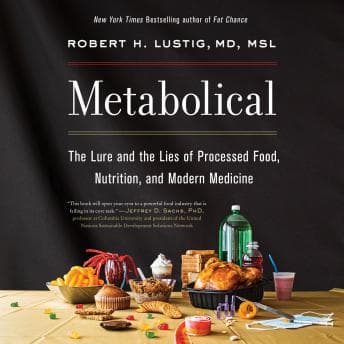
That question kept circling my brain during a Saturday spent making my mother's rajma recipe — kidney beans simmering for hours, the whole apartment smelling like cumin and bay leaves — while Robert Lustig systematically dismantled pretty much everything I thought I understood about food, medicine, and the metabolic chaos happening inside our bodies. There's something darkly funny about listening to a book about how processed food is destroying civilization while you're cooking from scratch, alone, feeling briefly superior. (My therapist would have thoughts about that impulse.)
The Biochemistry of Why We're All Screwed
Lustig's central thesis is deceptively simple: chronic disease isn't about individual willpower or even genetics — it's about eight subcellular pathologies that processed food triggers and perpetuates. Glycation. Oxidative stress. Mitochondrial dysfunction. Insulin resistance. Membrane integrity. Inflammation. Epigenetics. Autophagy. He walks through each one like a professor who genuinely cannot believe his students haven't figured this out yet, connecting them back to the same root cause: what we eat.
The research actually shows — and Lustig hammers this repeatedly — that medicine has been treating downstream symptoms while ignoring upstream causes. He frames chronic disease as "not druggable but foodable," which is the kind of phrase that sounds like a bumper sticker until he backs it up with metabolic pathways and clinical data. His argument that the vegan-versus-keto debate is a false war? Genuinely fascinating. Both camps, he argues, are essentially advocating for real food over processed garbage. They just can't see past their tribal identities to notice they're fighting the same enemy.
What makes this book compelling is Lustig's willingness to name names. Big Food. Big Pharma. Big Government. He doesn't just gesture vaguely at systemic problems — he traces specific policy decisions, lobbying efforts, and regulatory failures that created the current mess. The USDA dietary guidelines section made me actually stop stirring and just listen. The protagonist here — because yes, I'm treating this like a case study, that's what I do — exhibits classic whistleblower psychology: someone who's seen the data, understands the stakes, and is genuinely furious that institutional inertia keeps winning. The psychological anatomy of someone who dedicates a career to being right in ways institutions refuse to acknowledge is something I've been obsessing over lately — Mastery traces that same archetype through historical figures with a depth that kept me annotating margins for weeks.
Twelve Hours Is a Lot of Biochemistry Through Your Earbuds
Here's where I have to be honest. This is a dense book. At twelve hours, with Charles Constant narrating, you're getting a firehose of scientific information delivered in a clear, steady voice. Constant handles the technical material well — he doesn't stumble over metabolic terminology, and there's a dry, almost professorial quality to his delivery that suits Lustig's tone. He's not trying to make biochemistry sexy. He's trying to make it comprehensible. And mostly he succeeds.
But — and this is significant — I found myself rewinding sections multiple times. The subcellular pathology chapters are genuinely difficult to absorb in audio format. Lustig references charts, data tables, and a supplemental PDF that obviously doesn't help when you're elbow-deep in kidney beans. I found myself asking: why does this book exist as an audiobook without more structural concessions to the format? A physical copy where you can flip back to a diagram would serve this material better for certain chapters. I bumped the speed to 1.25x during the more narrative policy sections and dropped back to 1x for the hard science. That helped.
The book mentions a supplemental PDF, which — fine, but if I'm listening on a jog or while cooking, I'm not pulling up PDFs. That's a format limitation, not really Lustig's fault, but it matters for the audiobook experience specifically.
When the Science Gets Personal
The section where Lustig discusses how processed food mimics addictive substances hit differently than I expected. This is a fascinating case study in how corporate food science has essentially reverse-engineered human reward pathways. He describes the bliss point — the precise combination of sugar, salt, and fat that triggers dopamine release — and suddenly you're thinking about every bag of chips you've ever "accidentally" finished. The psychology here is sound. Lustig understands that human behavior around food isn't about weakness; it's about a neurochemical system being deliberately exploited.
As someone who studies how narratives shape identity, I noticed Lustig is doing something clever: he's rewriting the shame narrative around obesity and metabolic disease. The story isn't "you failed." The story is "you were set up to fail." Psychologically, that reframe matters enormously.
Who Needs This (and Who Should Grab the Paperback Instead)
If you're interested in nutrition science and can handle dense material, this is worth your time. If you or someone you love deals with metabolic syndrome, Type 2 diabetes, or obesity, Lustig's "protect the liver, feed the gut" framework is practical and evidence-based. But if you're a casual listener looking for light health tips during your commute — this will lose you by hour three. Honestly, the people who'd benefit most from this should probably buy both the audiobook AND the print version. Listen for the arguments, read for the data.
My Prescription, Since Lustig's Giving His
This book made me angry in a productive way. Not at Lustig — at the systems he describes. It's imperfect as an audiobook experience because the material sometimes fights the format, but the core argument is rigorous, the science is serious, and Lustig's ability to connect metabolic biochemistry to food policy to environmental destruction is genuinely rare. Constant's narration is competent and clear without being memorable, which for a science book is probably exactly right.
The rajma turned out great, by the way. Real food. No added sugar. Lustig would approve.