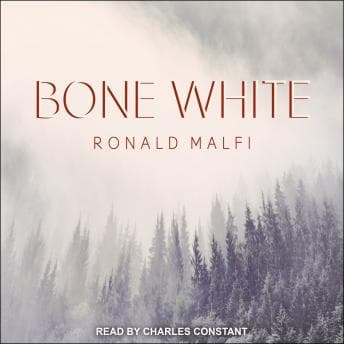

Ronald Malfi gets it. He understands that horror isn't about gore — it's about dread. And Bone White is dread distilled into almost eleven hours of Alaskan winter darkness, missing persons, and the kind of small-town silence that means everyone knows something they're not saying.
I was shelving returns at the library — late shift, fluorescent lights buzzing, nobody left in the building but me and the quiet — when I hit the stretch where Paul Gallo arrives in Dread's Hand. And I swear the temperature in the stacks dropped. Not really. But Malfi's prose does this thing where it makes you hyperaware of your own surroundings, and Charles Constant's narration leans into that so hard it's almost cruel.
The Devil's in Dread's Hand (and So Are You)
The setup is deceptively simple: a mass murderer is found in the Alaskan wilderness, and Paul's twin brother Danny went missing in the same area a year earlier. Paul goes looking for closure. He doesn't find it. What he finds instead is a community held together by superstition and dread — wooden crosses marking a boundary between civilization and something the locals won't name directly. Malfi takes his time here. This is a slow burn in the truest sense. The first few hours are grief and landscape and the bone-deep wrongness of a place that shouldn't exist but does.
Some listeners have called the pacing draggy, and I get it — if you need something to happen every twenty minutes, this isn't your book. But Malfi is building something. The way he layers Paul's guilt about Danny, the creeping unease of the locals' evasiveness, the physical hostility of the Alaskan setting — it's accumulative horror. Each chapter adds weight. By the time things start going genuinely wrong, you're already carrying so much tension that even small reveals hit like gut punches.
Shirley Jackson walked so this author could run. Not in terms of prose style — Malfi is earthier, less precise with his literary knife — but in his commitment to the idea that what you don't see is worse than what you do. The supernatural elements here aren't thrown at you. They seep in. The wooden crosses. The way people talk around what happened. The sense that the wilderness itself is sentient and hungry.
Charles Constant Knows What He's Doing
The narrator commits. That's rare. Constant does something genuinely unsettling with his delivery — there's this quality to his voice that's simultaneously reassuring and wrong, like a doctor who's telling you everything's fine while his eyes say otherwise. His pacing mirrors Malfi's prose perfectly: measured, unhurried, letting silences do work. When things get tense, he doesn't speed up or get louder. He gets quieter. Which is exactly right for this kind of horror.
His male voices are distinct and lived-in. Paul sounds like a man trying to hold himself together. The Alaskan locals each have their own rhythm and weight. Where Constant stumbles — and it's a minor stumble — is with female characters. They don't get the same specificity. They're there, they're fine, but they blur together in a way his male voices don't. For a book that's predominantly a masculine cast dealing with masculine grief in an unforgiving landscape, it's not a dealbreaker. But it's noticeable.
Production is clean. No weird artifacts, no jarring edits. Just you and Constant and the Alaskan dark.
The Ending Problem (and Why I Don't Entirely Mind It)
Look, some people are going to feel let down by the resolution. I've seen that criticism and I'm not going to pretend it's baseless. After all that slow-cooked tension and ambiguity, the final act makes choices that feel more conventional than what came before. The mystery of Dread's Hand is better as a mystery than as a solved equation.
But here's the thing — the journey there? The way Paul's search for Danny becomes something else entirely, the way the book shifts from grief story to survival story to something approaching folk horror? That's where the real power lives. And Malfi earns enough goodwill in those middle hours that I'm willing to forgive a landing that's slightly too clean.
I listened in the dark. Mistake? Maybe. Worth it? Absolutely. There's a sequence involving the woods at night and what might or might not be footsteps that had me checking the library's back door twice. Shirley (my cat) was unimpressed when I got home still jumpy. She's heard it all before.
Who Needs This in Their Ears
If you scare easily, skip. If you don't, you need this — but only if you have patience. This is horror for people who like their dread served cold and slow, not hot and fast. Fans of Dan Simmons' The Terror or Adam Nevill's The Ritual will feel right at home. I'd also throw Ice Princess into that pile — it's a different beast, more crime than folk horror, but that same oppressive Scandinavian cold does identical work on the psyche, and it stuck with me in ways I didn't expect. If you want action-horror or monster-of-the-week pacing, Dread's Hand will bore you before it scares you.
My podcast listeners are going to love this. Finally, horror that respects the genre — that trusts the audience enough to sit in discomfort without constantly reassuring them that something scary is coming. Because in Bone White, the scary thing is already there. It's been there the whole time. You just haven't looked closely enough yet.