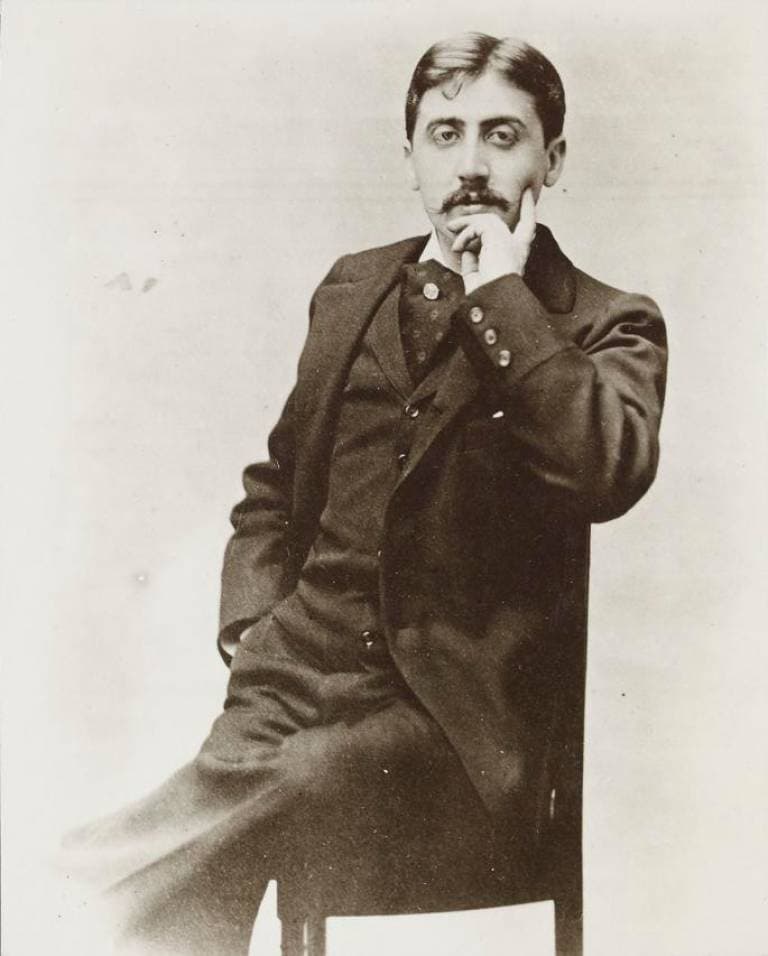

Look. I need to complain about something before we even get into this. Marcel Proust wrote sentences that run longer than some of my students' entire essays. Sentences that loop back on themselves, qualify their own qualifications, nest parentheticals inside parentheticals like Russian dolls made of silk and neurosis. These sentences are cathedrals. They are also, in the wrong narrator's hands, absolute torture.
And that's the problem here.
Nineteen Hours of the Same Note Played on the Same Piano Key
I started this during a Saturday lakefront walk with Denise. Beautiful October morning, wind off the lake, the whole thing. Proust describing the church steeples at Martinville as they shift and rearrange themselves from the moving carriage — that passage is one of the great set pieces in Western literature. It's the moment young Marcel discovers he might be a writer. It should hit you like a revelation.
It didn't. Because Expatriate reads it with exactly the same cadence, the same rising inflection, the same emotional temperature as the paragraph before it about going to bed early. And the paragraph after it about asparagus. Everything lands at the same altitude. The madeleine scene — you know, THE madeleine scene, the one that essentially invented the concept of involuntary memory as a literary device, the moment where a cookie dipped in tea unlocks an entire vanished world — gets the same tonal treatment as a description of wallpaper.
I kept waiting for a shift. Some gear change when we move from the dreamy Combray sections into "Un Amour de Swann," which is essentially a completely different kind of story — a third-person novella about jealousy and obsession and a man who ruins himself for a woman he doesn't even particularly like. That tonal pivot never came. Same inflections. Same intonations. Nearly every sentence treated as if it carries identical weight.
What Proust Actually Demands (And Why This Matters)
Here's the thing my students don't understand when I assign even small portions of Proust: the man was composing music. Those endless sentences aren't accidents or self-indulgence — they're rhythmic structures. The way a Proust sentence builds, digresses, circles, and then lands on a final phrase that recontextualizes everything before it? That's jazz. That's a musician who knows exactly where the resolution sits.
The narrator understands that pause is punctuation — or at least, a great narrator of Proust should understand that. Expatriate doesn't seem to. At nineteen hours, this is a substantial commitment, and the flat delivery turns what should feel like swimming through warm, perfumed water into something closer to... sitting in a waiting room. A very long waiting room. With fluorescent lighting.
I'll give credit where it's due: the recording is clean. No weird background noise, no technical hiccups. Expatriate's voice itself is pleasant enough — clear, measured, perfectly intelligible. If you need a Proust audiobook purely as a reference text, as something to follow along with while reading the physical book, this functions fine as that. But as a standalone listening experience? As performance? It doesn't get there.
This reminds me of what Hemingway said about prose being architecture, not interior decoration. Well, Proust's prose IS interior decoration — lush, obsessive, overwhelming decoration — and it needs a narrator who can inhabit that excess. Who can make you feel the difference between Swann's desperate midnight carriage rides searching for Odette and the gentle nostalgic ache of the Combray bedtime ritual. Those are completely different emotional frequencies. They can't live in the same narrow vocal band. I kept thinking about Anthony Marra's narrator in Constellation of Vital Phenomena, who somehow holds grief and dark comedy and tenderness in the same breath — proof that a skilled voice can carry wildly different emotional registers without flattening any of them.
The Proust Problem in Audio
I should be fair about something. Proust is maybe the hardest novelist alive (well, dead) to narrate well. The sentences are architectural nightmares for any reader — you have to hold the beginning of a thought in suspension while navigating three subordinate clauses, then land the ending with the right emphasis so the listener actually experiences the payoff. It's like narrating a maze. Most narrators would struggle.
But "most narrators would struggle" isn't really a defense when you've committed nineteen hours of your life. (I finished it over two weeks. Denise asked me twice why I looked so frustrated during our walks. I told her it was the wind. It wasn't the wind.)
If you loved the idea of reading Proust but bounced off the density, I'd still say audio is the right format. The prose deserves to be savored, and hearing it spoken aloud can untangle those gorgeous impossible sentences in ways that reading silently sometimes can't. But seek out a different version. This particular recording turns one of literature's great sensory experiences into background noise.
My students would hate this. I love Proust. I just can't love this version of him.
The Assignment: Who Should Bother
Proust completists who want a free LibriVox option and don't mind a flat reading — this exists, and it's technically competent. But if you're coming to Swann's Way for the first time and hoping to understand why people lose their minds over this book? This narration will actively work against you. Find a version where the narrator sounds like they've fallen in love with these sentences. Because Proust wrote them that way — as love letters to consciousness itself. They deserve someone who reads them like they mean it.