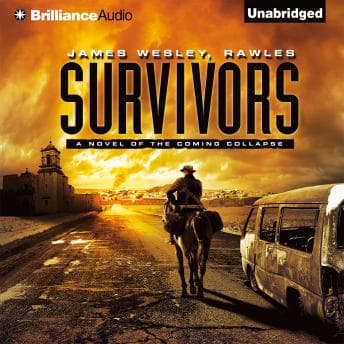

"The power grids are down. Brutal rioting and looting grip every major city."
I was three hours deep into this one, lights off in my apartment (because I'm apparently incapable of learning), when Shirley jumped onto my chest and I nearly threw my phone across the room. Not because of the cat. Because Rawles had just described a supply chain collapse scenario that felt less like fiction and more like a very detailed warning.
Here's the thing about *Survivors*: it's not horror in the traditional sense. No monsters. No supernatural dread. But there's something deeply unsettling about a novel that reads like a survivalist's instruction manual wearing a thriller's clothing. The Crunch—Rawles' term for the economic apocalypse at the heart of this book—hits with a plausibility that kept me checking my phone for news alerts.
When the Prep Manual Becomes the Plot
If you've listened to Rawles' *Patriots*, you know what you're getting into. *Survivors* exists in the same post-collapse universe, but where *Patriots* had a certain sardonic edge, this one plays it straighter. More serious. More... earnest? The material doesn't leave much room for dark humor, and honestly, that's both its strength and its limitation.
The narrative jumps between multiple survivor groups navigating a world where hyperinflation has rendered money meaningless and the social contract has dissolved. There's genuine tension in watching characters figure out water purification, establish community defense, and grapple with the moral compromises survival demands. That same tension—watching ordinary people navigate impossible moral territory—is what makes Four Blind Mice work, though the stakes there are more personal than apocalyptic. Rawles clearly knows his stuff; the man's a survivalist expert, and it shows. Every detail about firearms, food storage, and tactical movement feels meticulously researched.
But—and this is where my podcast listeners would start nodding—the characters themselves sometimes feel like vehicles for information delivery rather than fully realized people. The plot keeps moving, sure. Lightning-paced, even. But I found myself more invested in the *how* of survival than the *who* doing the surviving.
Dick Hill's Voice in a World Gone Quiet
Dick Hill is a Golden Voice narrator. Three Audies. Multiple Earphone Awards. The man has credentials. And his voice itself? Clear, easy to hear, excellent tone and pronunciation. When he's reading the serious, detailed survival content, he's in his element.
But here's where it gets complicated.
Hill attempts character differentiation by modulating his own voice for different characters. Men, women, children—he tries them all. And look, I appreciate the commitment. I do. But his deep male voice attempting to emulate women and children... it's distracting. Really distracting. There were moments where I'd be fully immersed in a tense scenario, and then a female character would speak, and I'd be yanked right out of the narrative.
This is a divisive narrator performance. Some listeners praise his clarity and professionalism. Others have called it one of the worst they've experienced. I land somewhere in the middle—technically proficient, but the character voice attempts actively work against the immersion the material is trying to build.
The Elephant in the Bunker
I can't write this review without addressing the political and religious overtones. They're present. They're not subtle. Some listeners find them preachy. Some find them creepy. Your mileage will vary dramatically depending on your own worldview.
My take? Horror—and yes, I'm categorizing this as horror, the existential kind—works best when it doesn't tell you what to think. When it presents a terrifying scenario and lets you sit with the implications. *Survivors* occasionally crosses the line from "showing" to "preaching," and those moments pulled me out of the narrative almost as much as the voice work did.
Who Should Queue This Up (And Who Should Skip)
This is a road trip audiobook. Thirteen hours and thirty-nine minutes of detailed survival scenarios that work surprisingly well during long drives—the material demands attention, but not the kind that makes you miss your exit. Engaging enough to keep you alert, serious enough to feel like you're learning something.
If you're into prepper fiction, if you want to know what a realistic economic collapse might look like, if you can tolerate some ideological heavy-handedness in exchange for genuinely useful survival information presented in narrative form—this delivers.
Skip it if you need deep character development, if narrator voice changes pull you out of stories, or if you're sensitive to political messaging in your fiction. Maybe borrow this one from the library first.
Checking My Pantry Now
Shirley remained unimpressed throughout. But she's never been one for practical preparedness. Me? I found myself inventorying my canned goods afterward. Make of that what you will.