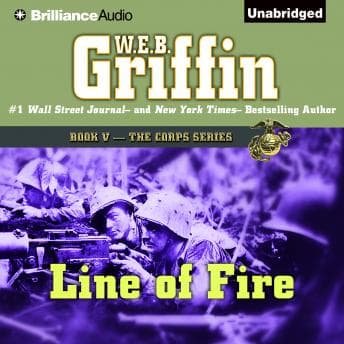

I was walking the lakefront with Denise last Saturday — one of those rare Chicago mornings where the wind off the lake isn't actively trying to kill you — and I realized I'd been listening to Line of Fire for nearly three hours without once checking how much time was left. That's the Griffin test, honestly. The man writes military fiction the way Hemingway wrote fishing scenes: all surface tension hiding enormous depth underneath, and you don't realize how deep you've gone until you come up for air.
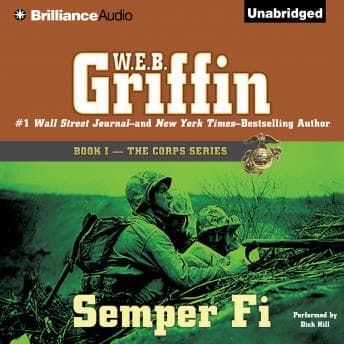
This is book five in Griffin's Corps series, and it picks up with two Marines stuck on Buka Island running Coastwatcher operations — basically reporting Japanese air activity from a position that's about as safe as a substitute teacher on a Friday afternoon. The rescue mission that gets assembled around them is the spine of the book, but Griffin being Griffin, that spine branches into about fifteen different storylines across the Pacific Theater, Washington D.C. backrooms, and various military bureaucracies where the real wars get fought.
Dick Hill Turns a War Into a Conversation
Let me compare this to something. If you've listened to any of the earlier Corps books with Dick Hill narrating, you know what he does — but Line of Fire might be where he's doing it best. Hill has this ability to shift between characters not just with voice changes but with tempo. His officers speak with clipped authority, his enlisted men drawl or clip depending on where they're from, and his Washington politicians have this oily smoothness that made me genuinely irritated during a scene where bureaucrats are debating rescue logistics while men are dying. That's not just reading. That's interpretation. Hill uses silence the way Griffin uses short declarative sentences. To hit you.
What strikes me about Hill's work here versus, say, a narrator tackling literary fiction is the sheer volume of characters he has to keep straight. This isn't a two-person stage play. Griffin populates his novels like a general staffing a campaign, and Hill gives each one enough distinction that by hour six I could identify who was speaking before the attribution. The Coastwatchers on Buka sound different from the brass in D.C. Not just different accents — different energy levels, different urgency. The guys on the island sound like men rationing every word because they might be rationing everything else too.
Griffin Wrote Military Fiction Like He Lived It (Because He Did)
Here's what separates Griffin from most military thriller writers, and it's something I try to explain to my students when we talk about authenticity in prose: Griffin served. He was in the Army. And you can feel it in the way he handles the mundane machinery of war — the logistics, the chain of command frustrations, the paperwork that sits between a good idea and actual action. The Buka Island rescue isn't just dramatic. It's procedurally convincing. You believe these are real operational constraints, real inter-service rivalries, real men trying to navigate a system that wasn't designed for heroism.
Griffin knew this world. The battle scenes in the Solomons hit hard not because they're gratuitously violent but because they're specific. Specific weapons, specific terrain, specific tactical decisions that go wrong in specific ways. At seventeen hours and fifty-five minutes, the book has room to breathe, and Griffin uses that room the way a good historian would — to build context before building tension.
Now, is this perfect? No. Griffin's tendency to juggle multiple storylines means some threads feel thinner than others. There are stretches — maybe thirty or forty minutes at a time — where you're following a subplot that doesn't have the same voltage as the Buka situation, and at 1.0x — the speed I chose for this one — those stretches require some patience. But I'll admit there were moments during a late-night grading session where I had to rewind because my attention drifted during a D.C. political maneuvering scene.
Who Gets Pulled In and Who Stays Ashore
If you loved James Jones's The Thin Red Line or Herman Wouk's The Winds of War, this is their spiritual successor in audiobook form — less literary, more propulsive, but carrying the same respect for the men who actually fought. If you've been following the Corps series, this is essential. If you haven't, you can start here, but you'll miss some character history that gives the emotional beats their full weight.
Skip this if you need constant action. Griffin is a slow builder. He's laying foundations for half the book before the explosions start, and if that sounds like a criticism, it isn't. It's architecture. The slow-burn structural patience reminded me of what I found in White Tiger — a book that also asks you to trust the foundation before it lights the fuse.
Slow, procedural, and absorbing almost against your will — a rarer combination than it should be.
The Assignment I'd Actually Give
Eighteen hours with Dick Hill and W.E.B. Griffin is a commitment — roughly the same time it takes me to grade one class's worth of essays on The Great Gatsby. But it's a commitment that pays off. Hill's Golden Voice credentials aren't just marketing; the man performs this material with the kind of controlled intensity that makes you forget you're listening to one person in a recording booth. And Griffin tells a war story the way it should be told: with respect for the boredom, the bureaucracy, and the bravery in equal measure.