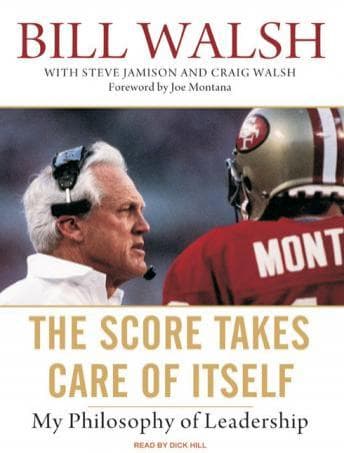

I was sitting in my home office at 11:30 PM last Tuesday, going through a founder's pitch deck that had no business being 47 slides long, when I realized I'd been listening to Bill Walsh talk about how he organized the 49ers' office seating chart for the past twenty minutes. And I wasn't bored. That's when I knew this book had something.
Bottom line: The Score Takes Care of Itself is one of maybe five business-adjacent books I've listened to in the past two years where I thought, "My parents would actually recognize this." Not the football parts — my dad couldn't name a single 49er — but the obsessive, grinding, process-over-results philosophy that Walsh built his dynasty on. That's a dry cleaning business owner's religion right there.
The Standard of Performance Is the Whole Book
Walsh's central idea — his "Standard of Performance" — is deceptively simple: define excellence in every behavior, no matter how small, and the winning takes care of itself. He's talking about how players tucked in their jerseys. How the receptionist answered the phone. How coaches parked their cars. This is the kind of granular, almost neurotic attention to process that most leadership books wave at from a distance before pivoting to some inspirational story about Elon Musk or whoever.
Walsh doesn't pivot. He stays in the weeds. He talks about scripting the first 25 plays of every game — not because he could predict what would happen, but because preparation eliminates panic. He describes taking over a 2-14 team and spending his first weeks not installing a new offense but teaching people how to act like professionals. The man reorganized how the equipment was stored before he redesigned the playbook.
I've seen this work at startups. I've also seen founders skip straight to the "vision" stuff and wonder why their teams can't execute a Tuesday standup meeting. Walsh would've eaten those founders alive.
Where Dick Hill Earns His Keep (and Where He Doesn't)
Dick Hill narrates this with the steady, authoritative delivery of a guy reading a well-written business memo — which is basically what large chunks of this book are. He's clear, he's professional, and he doesn't try to do dramatic character voices for Walsh's anecdotes, which is the right call. Walsh's words carry their own weight. Hill's job is to get out of the way, and he mostly does.
That said, I'll be honest — at 1.0x this is an 11-hour listen and the first hour-plus feels like setup that could've been trimmed by half. Walsh's early career background is important context, but the pacing drags before you get to the real operational philosophy. I bumped to 1.5x for that stretch and didn't miss anything. Once Walsh starts breaking down specific decisions — how he handled the 1981 NFC Championship, how he managed ego-driven players like Ronnie Lott, how he navigated the pressure of defending championships — Hill's steady cadence actually works in your favor. It lets you absorb the principles without feeling like you're being sold something.
No Audie-winning theatrics here, but the man knows how to deliver instructional content. That counts.
The 45 Minutes of Gold (Times Four, Actually)
Here's where Walsh surprised me. Most leadership books give you one good framework wrapped in 200 pages of filler. Walsh gives you several that actually hold up:
The scripted play concept — preparation as anxiety management. His approach to criticism ("Ignore the undeserved. Learn from the deserved. Lick your wounds. Move on.") is the most practical advice I've heard on the topic, and I've sat through a hundred executive coaching sessions. His insistence that leaders must teach, not just direct, is something I now repeat to every founder I work with.
But my favorite insight is his take on organizational decline — Walsh dedicating a whole section to what happens AFTER you succeed. How complacency creeps in. How the very confidence that winning creates becomes the thing that destroys you. This is what my parents did instinctively — they never celebrated a good month because they knew a bad one was coming. Now it has a TED talk. That same grinding, eyes-open refusal to get comfortable — the kind that never makes it into business school case studies — is what Bryan Stevenson captures in a completely different context in Just Mercy, where the work itself is the only metric that matters and celebration is a luxury nobody can afford.
The book does repeat itself in places. Walsh circles back to the Standard of Performance enough times that you'll get the message even at 2.0x. And Craig Walsh's supplemental sections, while well-intentioned, feel like DVD bonus features — nice to have but not essential.
Who Gets the ROI
If you run a team of any size and you're tired of leadership books that sound like LinkedIn posts with better formatting, this is your book. If you're a football fan, the 49ers stories alone justify the listen. If you're neither — if you want quick hacks and "passive income" shortcuts — Walsh would probably tell you to tuck in your jersey and try again.
Skip to chapter 5 if the early biographical stuff is losing you. Thank me later. But come back for the rest — the second half of this book is dense with applicable strategy.
Jenny would say I'm being harsh about the slow opening. Jenny is right. But Walsh earned my patience, and that's not something I say often about an 11-hour business audiobook.