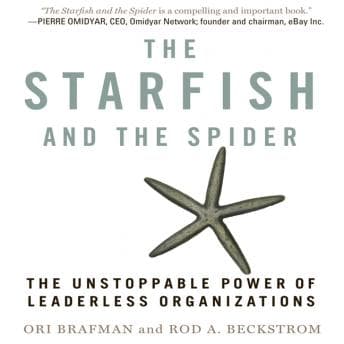

"If you cut off a starfish's leg, it grows a new one, and the old leg can grow into an entirely new starfish."
That's the central metaphor, and honestly? You get it within the first 20 minutes. The remaining 5 hours are the authors stretching that metaphor across every conceivable domain - the Apache resistance to Spanish colonization, AA's decentralized model, Napster and P2P networks, Wikipedia, craigslist. And look, some of those case studies genuinely land. But let's talk about the ROI on this audiobook first.
The Blog Post Problem (Yes, It's One of Those)
I bumped this up to 1.75x about forty minutes in, which is my universal tell for "this could've been a blog post." At 5 hours 33 minutes, it's not a huge time commitment, but the core thesis - decentralized organizations are resilient and powerful in ways centralized ones aren't - gets established early, and then we're basically looking at the same idea through twelve different lenses. If you've worked in distributed systems (hi, that's literally my job), the starfish/spider framework maps pretty cleanly onto centralized vs. decentralized architectures. Single point of failure vs. fault tolerance. I kept thinking about it in terms of microservices vs. monoliths, and honestly that mental exercise was more interesting than some of the later chapters.
The Apache case study is the strongest section by far. The way the authors trace how Spanish military strategy kept failing because there was no central leader to capture or kill - that's genuinely fascinating and I hadn't encountered that framing before. The concept of the "catalyst" (someone who starts decentralized movements and then steps away) versus a traditional CEO is a useful distinction. But by the time we get to the eBay and craigslist examples, you can feel the pattern: introduce organization, explain why it's a starfish, explain why its competitors are spiders, repeat.
Kevin walked in while I was making dinner and I was listening to the section about hybrid organizations - companies that combine starfish and spider elements. He asked what I was listening to and I explained the concept in about 90 seconds. He said "that sounds like the whole book." Reader, he wasn't wrong. The ability to distill a concept that cleanly in conversation is actually a skill worth developing on its own — Dale Carnegie & Associates' Listen! made me think harder about that side of communication than this book ever did, though it has its own padding problem.
Sean Pratt at 1.75x Is... Fine
Sean Pratt reads this in a clean, neutral tone that sounds like a competent business presentation. Not bad, not memorable. He keeps the energy conversational enough that it doesn't feel like someone reading a textbook, but there's a flatness that creeps in during the more analytical sections - the frameworks, the numbered lists of organizational principles. At 1.75x he sounds brisk and professional, which is actually an improvement over standard speed where some passages drag.
No character voices to speak of (this isn't that kind of book), no sound effects, no production issues. The audio is crisp. It's just... utilitarian narration for a utilitarian book. Pratt does a decent job differentiating when the text shifts between the two authors' perspectives, giving slightly different energy to Brafman's anecdotes versus Beckstrom's more structured arguments. But this isn't a performance you'll remember.
What Actually Stuck With Me
Here's what surprised me: the book was published in 2006, and some of its predictions about decentralized organizations have aged really well. The discussion of how fighting P2P networks with litigation just spawned more distributed alternatives? That's basically what happened. The idea that you can't kill a starfish by attacking it the same way you'd kill a spider - every tech company that's tried to squash open-source competition has learned this lesson.
But some examples feel dated in a way that undermines the thesis. The breathless treatment of craigslist and eBay as revolutionary starfish organizations hits different in 2024 when both have become pretty centralized platforms with their own bureaucracies. The book doesn't really grapple with what happens when starfish organizations scale and start developing spider-like structures - which is, like, the most interesting question.
The "five legs of the starfish" framework (circles, the catalyst, ideology, the preexisting network, the champion) is useful shorthand if you're thinking about building decentralized teams or communities. I can see pulling that out in a product strategy meeting. But it's a framework that could fit on a single slide.
Who Gets Value Here (And Who Doesn't)
Perfect for: train, gym. Skip for: deep work (you won't need deep work for this).
If you've never encountered decentralized organizational theory, this is a solid, accessible intro. The metaphor is sticky, the examples are entertaining enough at 1.75x, and at under 6 hours it won't eat your whole week. If you've read anything about network effects, open source movements, or organizational design in the last decade, you're going to spend most of this book nodding along to things you already know.
I finished this in 3 commutes, and I don't regret the time, but I also don't think I needed the full book. The first two hours give you 80% of the value.
Ship It, But Maybe as an MVP
TL;DR: Worth your commute if the concept is new to you, but this is a blog post wearing a book's clothes. Solid central metaphor, decent case studies, diminishing returns past the halfway mark. The kind of business book where the framework is genuinely useful even if the delivery is padded. At 1.75x and 3 hours of actual listening, the cost-benefit math works out. Just don't expect it to change your worldview if you've already spent time thinking about decentralization in any domain.