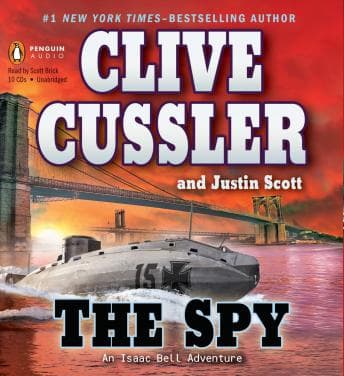

"Hull 44."
Those two words kept bouncing around my head somewhere around hour six, right as I was supposed to be debugging a procedural dungeon generator for my thesis. (Spoiler: I was not debugging anything.) Isaac Bell's investigation into this mysterious naval project had me completely ignoring my IDE while Scott Brick's steady, authoritative voice walked me through 1908 America like a history professor who actually knows how to tell a story.
When Your D&D Campaign Gets a Naval Warfare Expansion
Look, I'll be upfront—this isn't Sanderson-level world-building with intricate magic systems and carefully defined limitations. But Cussler and Scott are doing something different here, and it works. They're building a historical sandbox where the "magic system" is early 20th century technology: dreadnought battleships, revolutionary gun designs, the kind of engineering that made the Great White Fleet possible. That same era's technological tension—when the old world was giving way to something new and terrifying—is what makes Strange Case of Jekyll and Hyde still hit so hard, even in a dramatic reading format. As someone who's spent way too many hours homebrewing naval combat rules for D&D, I genuinely appreciated the attention to period-accurate military tech.
The spy thriller elements play out like a well-structured campaign. You've got your main quest (clear the dead inventor's name), your faction intrigue (German, Japanese, AND British spies all circling the same prize), and your set-piece locations that any GM would kill to run—Chinatown, Hell's Kitchen, the Brooklyn Navy Yard. Each location gets its own distinct flavor, and Bell moves through them like a player character who actually bothered to invest in Investigation checks.
Scott Brick Does the Heavy Lifting
Here's the thing about Scott Brick—the man is basically the Matt Mercer of audiobook narration for this genre. Not flashy, not doing wild character voice gymnastics, but absolutely rock-solid in a way that keeps you engaged for nearly thirteen hours. His voice has this natural gravitas that fits Isaac Bell perfectly. Bell's supposed to be this legendary Van Dorn detective, the guy everyone respects, and Brick sells that without ever overselling it.
I will say—and this is minor—I wished for a bit more vocal distinction between some of the supporting cast. When you've got German spies and Japanese agents and British operatives all scheming, it helps to have clearer audio cues for who's talking. Brick handles it competently, but Steven Pacey he is not. (Then again, who is? That man walked so other narrators could run.)
The Pacing Problem—Or Is It?
Some reviews I've seen call this one less engaging than other Cussler adventures, and I get it. There's a reviewer who described it as "honey for the ears but could have done with an occasional bee to offer a sting," and that's... actually pretty accurate? The Great Gatsby gets similar criticism for its measured pacing, but both books trust their period atmosphere to carry the weight. The plot unfolds methodically. Bell investigates, uncovers clues, connects dots. It's satisfying in a procedural way, like watching a competent player work through a mystery module.
But here's where I'll defend it: not every fantasy novel needs to be grimdark, and not every thriller needs breakneck pacing. Sometimes you want the slow build, the careful accumulation of tension. I was listening to this while pretending to work on my thesis (Dr. Patel, if you're reading this, I definitely was not), and the measured pace actually worked great for that half-attention listening state. Each discovery leads logically to the next, and when the bigger picture finally snaps into focus, it earns the payoff.
Who Should Saddle Up (And Who Should Ride On)
If you're looking for a historical adventure that respects its period setting without drowning you in info-dumps, this delivers. Fans of the Isaac Bell series will find exactly what they're expecting—competent, entertaining, well-researched fun. My D&D group would love this as inspiration for an early 1900s espionage campaign, honestly.
But if you need constant action beats or explosive set pieces every chapter, you might find yourself checking the progress bar. And if you're coming to Cussler for the first time, maybe start with one of the Dirk Pitt novels instead—this is solid mid-series work, but it's not the best introduction to his style.
Natural 20 on Comfort Food
I'm not going to pretend The Spy changed my life or made me rethink the genre. It didn't. What it did was give me nearly thirteen hours of well-crafted historical adventure narrated by someone who clearly knows exactly what kind of book he's reading. Scott Brick and Cussler's style fit together like a natural 20 on a performance check.
Is it worth a credit? If you're already invested in Isaac Bell, absolutely. If you're curious about the series, this is a perfectly fine entry point—just know you're getting competent comfort food rather than a five-course meal. I finished it, enjoyed it, and immediately went back to procrastinating on my thesis with a clear conscience.
(Dr. Patel, I promise the procedural generation chapter is coming. Eventually.)