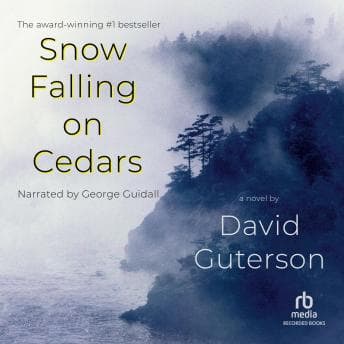

I started this at 11 PM, grading a stack of junior essays on The Great Gatsby. By 2 AM, the essays were forgotten, my red pen had rolled under the couch, and I was still listening. Denise found me the next morning, coffee cold, laptop dead, George Guidall's voice still playing through my headphones. She just sighed. She knows.
Here's the thing about Snow Falling on Cedars that nobody prepared me for: it's not really a courtroom drama. I mean, yes, there's a Japanese-American fisherman named Kabuo Miyamoto on trial for murder. Yes, the prosecution builds its case. But Guterson uses that trial the way Faulkner uses Yoknapatawpha—as a frame to hold something much bigger, much sadder, much more American.
The Architecture of Memory
Guterson structures this novel like memory itself works—non-linear, associative, triggered by sensory details. We're in the courtroom, then suddenly we're in an internment camp. We're watching the accused, then we're inside a teenage love affair on a strawberry farm. The snow keeps falling. Time keeps folding.
This is why the audiobook format works so beautifully here. Reading Guterson on the page, you control the pace. You can rush through the slower passages about cedar trees and fishing nets. But Guidall won't let you. He understands that Guterson chose those words, those rhythms, those pauses between clauses. The prose deserves to be savored.
My students would hate this. I love it.
Guidall and the Weight of Silence
I've listened to maybe two hundred audiobooks at this point. I know good narration. What Guidall does here is different—he inhabits the pauses. When Ishmael Chambers, the one-armed journalist who still loves Hatsue after all these years, watches her across the courtroom, Guidall lets that silence breathe. You feel the weight of unspoken history.
His voice for Hatsue's mother carries this particular formality—not an accent, exactly, but a precision in the consonants that suggests someone speaking English as a second language with perfect grammar and careful pronunciation. Contrast that with the rougher, saltier voices of the fishermen, and you've got an entire social world rendered in vocal texture.
The courtroom scenes are where Guidall really earns his reputation. The shifts between testimony and memory, between public performance and private anguish—he navigates all of it with quiet authority. Never theatrical. Never pushing. Just... present.
The Iceberg Beneath the Trial
Let's talk about what Guterson is really doing here. On the surface, this is a murder mystery set in 1954 on a fictional island in Puget Sound. But underneath—and this is what made it win the PEN/Faulkner—it's an examination of how we carry history in our bodies.
The internment camps aren't just backstory. They're the wound that never healed. Every interaction between Japanese-American and white characters carries that weight. The romance between Ishmael and Hatsue isn't just forbidden love—it's two people trying to exist outside of history and discovering they can't.
Hemingway's iceberg theory applies here: seven-eighths of the meaning sits below the surface. Guterson shows you the trial, shows you the snow, shows you the cedar trees. But what he's really writing about is the impossibility of justice in a society built on injustice.
(Principal Martinez, if you're reading this, this is exactly the kind of thematic analysis I'm trying to get out of my juniors. They're not there yet. Neither was I at seventeen.)
The Snow as Character
I listened to the final four hours during a Saturday walk along the lakefront with Denise. It was actually snowing—one of those rare Chicago days where the lake goes gray and the sky goes white and everything feels suspended. Perfect conditions for the ending.
Guterson uses that snow the way a filmmaker uses a score. It muffles. It blankets. It covers and reveals. By the time the trial reaches its conclusion, you understand that the snow isn't just weather—it's the way memory works, the way guilt accumulates, the way small communities bury their sins under layers of politeness and tradition.
At fifteen hours and forty-five minutes, this is a commitment. Don't start it thinking you'll squeeze it between errands. This book wants your attention, your patience, your willingness to sit with discomfort. The pacing is deliberate—some would say slow, but I'd argue it's calibrated. Like Middlemarch. Like anything worth the time.
Who This Is For (And Who Should Skip It)
If you need plot momentum to stay engaged, this will test you—the deliberate pacing rewards patience, not impatience. But if you loved To Kill a Mockingbird, this is its spiritual successor—darker, more morally complicated, less interested in providing heroes. Billy Summers occupies similar territory—a protagonist wrestling with his own moral compromises while the world judges someone else. If you loved The Remains of the Day, you'll recognize the same quality of restrained devastation.
The 2000 film adaptation is decent—Ethan Hawke does fine work—but it can't capture what Guterson does with interiority. You need the words. You need Guidall's voice finding the rhythm in those long, gorgeous sentences.
Class Dismissed
This is why we still read the classics. And this, I think, will be one.