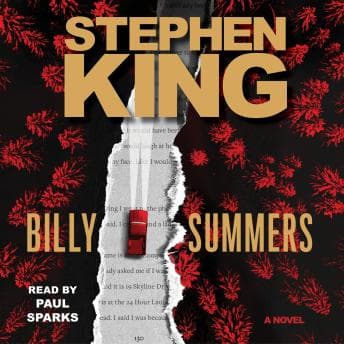

Look, I'll be honest with you. I started Billy Summers during one of Principal Martinez's legendary budget presentations—the ones that somehow last longer than the fiscal year they're discussing—and by the time he got to "projected facility maintenance costs," I was already three chapters deep and completely gone. Billy Summers had me. And I don't mean the distracted, half-listening kind of gone. I mean I missed my cue to vote on something about copy paper allocations because I was too busy watching Stephen King do something I genuinely didn't expect from him.
He wrote a love letter to writing itself.
What King Is Really Doing Here
So here's the setup: Billy Summers is a hitman. But he's a hitman who only kills bad people, which is the kind of moral compromise we tell ourselves makes everything okay. (My students do this with SparkNotes. "I only use it for the really boring books, Mr. Williams." Sure, kid.) Billy's cover for his final job? He pretends to be a writer working on a novel. And then—this is the part that got me—he actually starts writing one.
King embeds Billy's fictional memoir throughout the book, and it's... honestly, it's beautiful. There's this meta-layer happening where you're reading about a man discovering that writing is excavation, that putting words on a page forces you to confront things you've spent decades burying. This reminds me of what Hemingway said about writing hard and clear about what hurts. Billy doesn't know he's doing therapy. He thinks he's maintaining cover. But King knows. And we know.
The prose deserves to be savored here. King's always been accessible—my students can actually read him without complaining, which is saying something—but Billy Summers has this patient, deliberate quality. It's not horror-King. It's not even thriller-King, really. It's King writing about small-town America, about diners and neighbors and the weird intimacy of pretending to be someone you're not until you accidentally become someone better.
That same patient, character-first approach is what makes It work so well—King at his best when he lets you live in a place before the horror arrives.
My students would hate the pacing. I loved it.
Paul Sparks and the Art of Restraint
Okay, so Paul Sparks. Here's the thing—I couldn't find much about his audiobook background before this, and apparently some listeners had concerns about that. Those concerns were, to put it in terms my freshmen would understand, completely unfounded.
Sparks gets something fundamental about Billy that a flashier narrator might have missed: Billy is quiet. He's observant. He's the guy in the room you don't notice until it's too late. And Sparks plays him with this measured, almost flat affect that sounds boring on paper but works brilliantly in practice. He understands that pause is punctuation. When Billy's internal monologue shifts—when he's remembering Iraq, when he's writing his memoir, when he's falling into something unexpected with Alice—Sparks doesn't oversell it. He trusts the material.
The character voices are distinct without being cartoonish. Billy's handlers have this oily, corporate menace to them. The small-town folks Billy befriends sound genuinely warm. And when things go sideways in the back half—I won't spoil it, but there's a significant tonal shift—Sparks navigates it without whiplash.
Now. Fair warning. I've seen reviews where people found his voice grating, something about the mastering or the tone that just didn't work for them. I listened to probably twelve hours of this on lakefront walks with Denise (she was listening to some true crime thing, we have a system), and it never bothered me. But audio is subjective in a way print isn't. If you're sensitive to narrator voice, maybe sample first.
The Slow Burn and the Payoff
This is a seventeen-hour audiobook. That's not nothing. And King takes his time—the first act is almost entirely setup, watching Billy settle into his cover identity, make friends, write his book-within-a-book. If you need action every chapter, you're going to struggle.
But here's why it works: King is building something. When the violence comes—and it does, this is still Stephen King—it means something because you've spent hours in this quiet life Billy's constructed. You've watched him become attached to people he was supposed to ignore. You've read his fictional memoir and understood things about his childhood that he's only just processing himself.
The back half accelerates significantly. There's a rescue, a road trip, a reckoning. It earns its thriller classification eventually. But the heart of this book is the quiet middle, the parts where Billy discovers he might be more than what he does for a living.
If you loved The Shawshank Redemption or 11/22/63—King's more literary, character-driven work—this is their spiritual successor.
I'd put The Drawing of the Three in that same category of King doing more than genre expectations—different tone entirely, but the same commitment to making you care about broken people trying to be better.
Who Should Listen (And Who Should Skip)
Best for: Long commutes. Serious walks. Anything where you can give it sustained attention. This isn't a workout book—the pacing's too deliberate, you'll miss things. It's a "grading papers at 11 PM" book, a "pretending to pay attention in meetings" book. (Worth pausing the faculty meeting for, honestly.)
Skip if: You want constant action, you're impatient with slow builds, or you've got issues with narrator voice in general. Also, content warnings for violence, language, and some sexual content—it's King, he doesn't sanitize.
I listened at 1.0x because the author chose those words and Sparks chose those pauses. Speeding this up would be like fast-forwarding through the quiet parts of a Coen Brothers movie. You'd technically get the plot, but you'd miss the whole point.
Final Grade
Billy Summers is Stephen King writing about redemption, about the stories we tell ourselves and the ones we're afraid to tell anyone else. Paul Sparks delivers it with restraint and intelligence. It won an Earphones Award, which tracks—this is genuinely excellent audio production married to genuinely excellent source material.
Is it King's best? I don't know. That's a long list. But it's the King book I'd hand to someone who thinks he only writes horror. It's the one I'd assign if I taught a unit on contemporary American fiction. (I don't. The curriculum committee would never approve it. But I'd want to.)
Seventeen hours well spent. Even if I did miss that vote about copy paper.