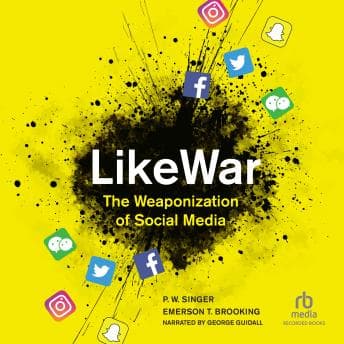

I listened to this on the 6:14 AM Baby Bullet to Mountain View, staring at a car full of exhausted engineers doomscrolling on their phones. It was... meta.
Most of the time, when people talk about "Cyber War," they mean shutting down power grids or stealing credit card data—stuff that my team worries about in distributed systems. LikeWar argues that we're missing the point. The new battlefield isn't the infrastructure; it's the information itself. It's a Layer 8 vulnerability (tech speak for "the user is the problem").
Singer and Brooking lay out a terrifying, comprehensive post-mortem of how the internet went from a libertarian utopia to a weapon system. The specific examples are wild. You've got ISIS recruiters studying Taylor Swift's social media strategy to maximize engagement. You've got a random accountant in Georgia (the state, not the country) using open-source intelligence (OSINT) to triangulate terrorist locations better than the CIA. It's basically Black Mirror but with footnotes.
The "Guidall" Factor
Here's the thing about the audio: It's narrated by George Guidall. If you listen to as many audiobooks as I do, you know Guidall is the voice of gritty spy thrillers, westerns, and high-stakes fiction. Hearing his gravelly, grandfatherly voice pronounce words like "tweet," "meme," and "troll farm" with the same gravitas he gives to a Tom Clancy novel creates this bizarre cognitive dissonance. And honestly? It works. It makes the absurdity of internet culture sound like the serious geopolitical threat it actually is. When he reads about "The Great Meme War," it doesn't sound funny; it sounds like history.
The ROI
The book is dense. I had to rewind a few times when they got into the weeds of Russian disinformation tactics—not because it's boring, but because the mechanics of how they game the algorithms are disturbingly brilliant. It explains exactly why your crazy uncle posts what he posts. The psychology behind it reminded me of Marshmallow Test: Mastering Self-Control—same impulse-driven behavior, different medium.
My only gripe? It was published in 2018. In internet years, that's a lifetime ago. Some references feel like looking at a time capsule, but the underlying architecture of the arguments—how virality trumps truth—is unfortunately more relevant now than when it was written.
Who Needs This in Their Queue
If you work in tech, this is mandatory documentation. If you're in policy, journalism, or just trying to understand why your social feeds feel like psychological warfare—same deal. Skip it if you want solutions; this is a diagnostic, not a patch. The 2018 timestamp means some examples are dated, but the exploit it describes? Still unpatched.
Closing the Loop
I finished it in three days of commuting and immediately changed my privacy settings. Then I deleted Twitter. (Okay, I didn't, but I thought about it.)





![Steve Jobs [unabridged audiobook] audiobook cover](/_next/image?url=https%3A%2F%2Fcovers.audiobooks.com%2Fimages%2Fcovers%2Ffull%2F9788499923406.jpg&w=1920&q=75)