
I was supposed to be grading junior essays on The Great Gatsby. It was 10:47 PM, Denise had already gone to bed, and I had exactly fourteen papers left. Then I made the mistake of pressing play on this under-two-hour essay, thinking I'd just sample the opening.
I did not grade those papers.
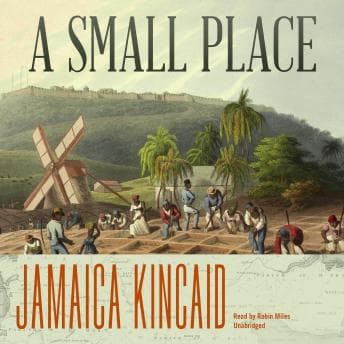
Jamaica Kincaid's A Small Place is not a book. It's an indictment delivered with the precision of a scalpel and the force of a sledgehammer. And Robin Miles—God help me—she narrates it like she's reading your sins back to you at the gates of judgment.
The Second Person That Won't Let You Look Away
Kincaid does something I've only seen a handful of writers pull off successfully. She writes in second person—"you"—and she means you. The tourist. The comfortable Westerner. The person who sees Antigua as a vacation destination and not as a place where actual people live with the wreckage of colonialism.
"If you go to Antigua as a tourist, this is what you will see." That opening line seems almost welcoming. Give it fifteen minutes. The hospitality curdles into something far more confrontational. Kincaid walks you through her island—the corrupt government, the crumbling library that's been "temporarily" housed in a decrepit building since an earthquake in 1974, the beautiful beaches that exist for your pleasure while locals can't afford the hotels built on their own shores.
This reminds me of what Swift did in "A Modest Proposal"—that same controlled fury dressed in the clothing of reasonable discourse. Karl Marx: An Essay has that same unflinching directness when dissecting power structures. Except Kincaid isn't being satirical. She's being devastatingly literal.
Robin Miles Understands That Pause Is Punctuation
Here's the thing about this audiobook: it's an hour and forty-eight minutes. You could listen to it during a lunch break. But Miles doesn't rush it. She lets Kincaid's sentences breathe—those long, winding, hypnotic sentences that circle back on themselves like a snake eating its own tail.
Miles reads with what I can only describe as dignified rage. There's no shouting. No melodrama. Just this steady, measured delivery that somehow makes every accusation land harder. When Kincaid describes the British tourists who don't seem to realize—or care—that they're walking through the aftermath of their own empire's destruction, Miles's voice carries a weight that made me set down my red pen and just... sit there.
I've listened to a lot of audiobooks. A lot of narrators. Miles doesn't perform this text. She presents it. Like evidence.
What My Students Would Call "A Lot"
I teach seventeen-year-olds. They'd find this uncomfortable. Which is exactly why I'm adding it to my supplemental reading list.
Kincaid doesn't offer easy answers or comfortable resolutions. She doesn't end with hope or a call to action or any of the things we've been trained to expect from essays about injustice. She just... shows you. The corruption. The poverty. The way tourism functions as a kind of ongoing colonialism with better PR. And then she leaves you sitting with it.
At one point, she writes about how Antiguans themselves have internalized certain colonial attitudes—and she doesn't exempt herself from criticism. That's what elevates this beyond polemic. Kincaid is too smart, too honest, to pretend the damage of colonialism is simple or one-directional.
The Brevity Is The Point
Under two hours. That's it. And yet I've been thinking about it for days.
There's something almost aggressive about how short this is. Kincaid says what she needs to say and stops. No padding. No repetition for emphasis. Just this concentrated dose of truth that hits harder precisely because it doesn't overstay.
I listened to it again the next morning while walking the lakefront. Different experience in daylight, with joggers passing and the Chicago skyline in the distance. Made me think about who built what. Who benefits. Who's invisible.
The prose deserves to be savored. Listen at 1.0x. Let the sentences do their work.
Who This Is For (And Who Should Maybe Brace Themselves)
If you want postcolonial critique that doesn't soften its edges for comfort, this is essential. Teachers looking for something short but devastating to pair with canonical texts—here you go. Skip it if you need your nonfiction to end with solutions or hope; Kincaid offers neither, and that's the point.
Class Dismissed (But The Lesson Stays With You)
This isn't a comfortable listen. It's not meant to be. Kincaid wrote this in 1988 and it feels like it could have been written yesterday—which says something about how little has changed and how much we still refuse to see.
Robin Miles's narration transforms an already powerful text into something that feels almost uncomfortably intimate. Like Kincaid is speaking directly to you. Because she is.
My students would hate this. I love it. Those fourteen Gatsby essays waited until the next night. They survived. So did I—though not unchanged.