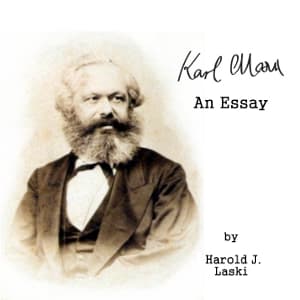

Look, I'll be straight with you - I picked this up expecting a dry academic slog. Two hours on Karl Marx written in 1922? My expectations weren't exactly sky-high. But Harold Laski surprised me. This isn't some starry-eyed tribute to Marx or a hit piece either. It's a sharp, critical examination from someone who clearly knew his stuff but wasn't afraid to call out the gaps in Marx's thinking.
Laski was the real deal - professor at the London School of Economics, Labour Party chairman, influenced half the independence leaders in Asia and Africa. The man had credibility. I got that same sense of intellectual weight from Winston Churchill, though Churchill's political journey went in a very different direction. And you can hear it in how he structures his arguments. He gives Marx credit where it's due while systematically dismantling the parts that don't hold up. That's intellectual honesty, and it's refreshing.
The Scholarly Approach That Actually Works
Here's the thing about political theory audiobooks - they can go sideways fast. Either the narrator tries to jazz things up and it feels ridiculous, or they drone on like a sedated professor and you're asleep in ten minutes. Phil Benson threads the needle. His delivery is clean, measured, and he doesn't try to be something he's not. Is it exciting? No. But it's not supposed to be.
I listened to this during a long drive to a client site in Houston. Three hours of Texas highway, just me and Ranger and Laski's century-old analysis of Marxism. The steady pacing actually worked for that context. I could process the ideas, think about them, disagree with a few points. The narration didn't get in the way of the content - and for material this dense, that's exactly what you want.
Some folks in the reviews complained about the delivery being monotone. Fair point. If you're expecting someone to bring theatrical energy to a 1922 political essay, you're going to be disappointed. But honestly? Dramatic flair would've felt wrong here. This is scholarship, not entertainment.
Where Laski Gets It Right (And Where He Doesn't)
Laski's strength is context. He situates Marx within his historical moment - the industrial revolution, the conditions that shaped his thinking, the intellectual currents he was swimming against. That's valuable stuff. Too many people argue about Marx without understanding what he was actually responding to. Radium Girls does something similar with the industrial revolution's darker side - showing the human cost of the same era that shaped Marx's thinking.
But - and this is where my own reading of history diverges - Laski sometimes gives Marx too much credit for predictive power. Written in 1922, he couldn't have known how the 20th century would unfold. Some of his assessments feel dated now, which is inevitable but worth noting. You're getting a snapshot of how intellectuals understood Marx a century ago, not a modern analysis.
The production quality is solid for a LibriVox recording. No background noise, no weird volume jumps. Just clean audio. Nothing fancy, but nothing distracting either.
SITREP: Worth Your Time?
At just over two hours, this is a manageable commitment. If you're studying political theory, this is useful primary source material - you're hearing how a major socialist thinker interpreted Marx during a pivotal period. If you're just curious about Marxism and want something more substantial than a podcast but less intimidating than Das Kapital, this works.
Who should listen: Students of political theory, history buffs curious about early 20th-century socialist thought, anyone wanting a digestible entry point to Marx criticism. Who should skip: If you need modern production values or energetic narration to stay engaged, look elsewhere. And if you're hoping for a balanced left-right perspective, that's not what Laski was doing - he was a committed socialist analyzing a fellow traveler.
I'd recommend bumping the speed to 1.25x. Benson's pacing is deliberate enough that you won't lose anything, and it tightens up the listening experience.
Ranger slept through most of it, but that's not necessarily a criticism. Sometimes the best audiobooks are the ones that give you space to think. This one did that. Mission accomplished.






![Steve Jobs [unabridged audiobook] audiobook cover](/_next/image?url=https%3A%2F%2Fcovers.audiobooks.com%2Fimages%2Fcovers%2Ffull%2F9788499923406.jpg&w=1920&q=75)