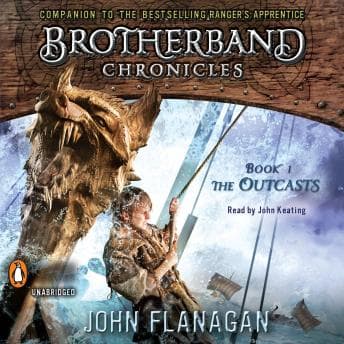

Stuck in an airport lounge waiting for a delayed flight to Seattle - client emergency, naturally - when I realized I'd finished my current business book and needed something to pass three hours. My nephew had been bugging me to try this series since Christmas. Kid logic: if Uncle David reads boring business stuff, he needs 'real adventure.' So I finally caved.
Bottom line: This is a 12-hour investment that delivers exactly what it promises - competent adventure storytelling with solid values baked in. Not revolutionary, but respectable.
What My Parents Would Recognize
Here's the thing about Flanagan's Brotherband series that caught me off guard. The Heron crew operates like a small family business. Hal's the leader, but he's constantly delegating based on individual strengths. Stig handles muscle. Ingvar's the heavy lifter. Edvin's the medic. Everyone has a role, everyone contributes, nobody's dispensable.
This is what my parents did instinctively. Now it has a TED talk.
The plot's straightforward: Tursgud - the bully from earlier books - has become a slave trader. He kidnaps twelve Araluen villagers. The Herons go after him, teaming up with a Ranger (crossover appeal for the Ranger's Apprentice fans). They infiltrate Socorro, plan a rescue, execute under pressure.
No wasted subplots. No filler chapters. Flanagan respects the reader's time, which I appreciate more than I can express after suffering through business books that pad 30 minutes of insight into 8 hours of audio.
John Keating Earns His Pay
The narrator situation here is genuinely impressive. Keating differentiates every character - and there are a lot of them - without making it feel like a one-man circus. He brought that same precision to Icebound Land: Book Three, which is actually where I first noticed how clean his character separation is under pressure. Hal sounds young but competent. Thorn (the grizzled mentor) has this weathered edge. The Ranger Gilan gets a slightly different register that signals 'outsider joining the crew.'
What really sold me: Keating handles the action sequences without losing clarity. When you've got multiple crew members shouting during a ship battle, you need to know who's speaking. He delivers. I listened at 1.5x (couldn't quite do my usual 2.0x with all the character switching) and never got lost.
The pacing matches the narration - steady build through the first half as they gather intel and plan, then accelerating through the rescue operation. It's structured like a good consulting engagement: research phase, strategy phase, execution phase. (Jenny would say I'm being harsh comparing a kids' adventure book to McKinsey project management. Jenny is right.)
The ROI Question
Is this worth 12 hours? Depends on your use case.
If you're a parent looking for something to share with kids 10+, absolutely. The values are solid - teamwork, loyalty, using your brain before your sword. There's violence, but it's handled with consequences. Characters get hurt. Decisions have weight.
If you're an adult looking for escapism, it's competent but not complex. The good guys are good. The bad guys are bad. Tursgud's a one-dimensional villain - he was a bully, now he's a slaver. No redemption arc, no moral ambiguity. That's fine for the target audience, but don't expect Game of Thrones (despite what the marketing copy suggests - that comparison is absurd, by the way).
If you're already invested in the series, this is a strong entry. The crew dynamics feel earned from previous books. The Ranger crossover adds fresh energy without derailing the core team.
Skip to Chapter 5? Actually, No.
Rare for me to say this, but the setup chapters matter here. Flanagan uses the early sections to establish Socorro's layout, the slave market logistics, the guard rotations. It's worldbuilding that pays off during the heist. I've seen too many business books that could cut their first third entirely. This one actually uses its runtime.
The Socorro infiltration sequence is the highlight. Watching the crew adapt their plan in real-time, dealing with complications, leveraging individual skills - it's a case study in agile execution. (I'm doing it again. Jenny's giving me that look.)
Who Gets Value Here (And Who Doesn't)
Parents with adventure-loving kids: Strong buy. Clean enough for family listening, engaging enough that you won't zone out.
Series fans: Essential. Advances character relationships, delivers satisfying action, sets up future conflicts.
And if you want a sense of what Keating can do when the material gets darker and more emotionally demanding, Renegade's Magic is worth a listen - different world, same narrator discipline.Adults new to the series: Maybe start with book one. You'll appreciate the crew dynamics more with context.
Skip this if you're expecting the next Brandon Sanderson. This is middle-grade adventure, well-executed. It's not trying to be epic fantasy, and it shouldn't have to apologize for that.
The Dry Cleaning Business Verdict
My parents would've appreciated this book's work ethic. No shortcuts. No gimmicks. Just competent storytelling that does exactly what it promises. Hal's crew reminds me of those 14-hour days in Koreatown - everyone pulling their weight, no job too small, success through collective effort.
My nephew's getting a text. He was right. Sometimes you need a break from business books.
The key takeaway is worth the listen. The other 11 hours? Actually worth it too.