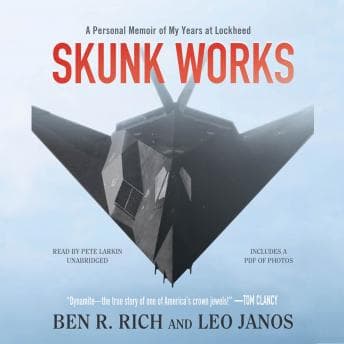

I was sitting on my back porch at 0200, couldn't sleep - one of those nights where the brain won't shut off - and Ranger was doing his usual thing, snoring at my feet while I stared at the Texas sky. Perfect time to start a book about the people who built machines that owned that sky.
Let me cut to the chase: Skunk Works is one of the best nonfiction audiobooks I've listened to this year. Maybe in the last five years. Ben Rich ran Lockheed's legendary black projects division after Kelly Johnson, and this memoir covers everything from the U-2 to the SR-71 to the F-117 Stealth fighter. If you care about aviation, Cold War history, or just how a small team of brilliant, stubborn engineers changed modern warfare - this is required reading.
Where the Engineers Were More Dangerous Than the Pilots
What makes this book different from your typical military history is the perspective. Rich isn't writing from the cockpit or the Situation Room. He's writing from the shop floor and the budget meetings. You get the story of how the Stealth fighter's radar cross-section was reduced to something smaller than a bird - and then you get the story of Rich trying to convince Pentagon brass to actually fund the thing. The bureaucratic knife fights are almost as intense as the flight test sequences.
Rich has this dry, engineer's sense of humor that comes through even in audio form. There's a moment where he describes proving stealth technology to a skeptical general by handing him a ball bearing and saying something like, "Here's your airplane on radar." That kind of swagger - backed up by actual results - is what made Skunk Works legendary. The book is full of those moments where you realize these people weren't just building airplanes. They were rewriting the rules of what was possible.
The structure alternates between Rich's narrative and first-person accounts from CIA operatives, test pilots, and engineers who were there. It's a smart approach. You get Rich's strategic view of a program, then a pilot drops in to tell you what it was actually like flying a U-2 at 70,000 feet over the Soviet Union with SAMs coming up. The contrast keeps the 12 hours moving.
Pete Larkin and That New England Thing
Pete Larkin narrates, and he's solid. Good gravitas, appropriate weight for the material. His voice has this New England quality to it - kind of an old-school, scotch-and-leather-chair vibe - that actually works well for a book set in the Cold War era. Rich was a no-nonsense California engineer, not a Boston Brahmin, so there's a slight mismatch, but Larkin sells the authority and the emotion behind the stories well enough that I didn't mind.
Here's my honest assessment though: around the two-thirds mark, that accent starts to wear on you. It's not bad narration - it's just that 12 hours of the same vocal texture gets monotonous. The book shifts between multiple first-person perspectives, and Larkin doesn't differentiate voices dramatically enough. When a test pilot is talking versus a CIA case officer versus an engineer, you sometimes have to rely on context clues rather than vocal cues to know who's speaking. At 1.25x, which is how I listened, the pacing felt right and the accent was less noticeable. I'd recommend the same.
I've Seen This Scenario Play Out in Real Life
What Rich describes about the culture at Skunk Works - small teams, minimal bureaucracy, direct access between engineers and operators - is basically the opposite of how most military procurement works today. And that's the quiet tragedy running underneath this book. Rich isn't just telling war stories. He's making an argument that the system that produced the SR-71 and the Stealth fighter couldn't exist in today's acquisition environment. Too many layers, too many committees, too many contractors protecting their turf.
I've sat in enough Pentagon conference rooms to know he's right. The author clearly did their homework - or rather, Rich lived it, and Leo Janos (who also co-wrote Chuck Yeager's autobiography) knew how to shape the material into something that moves. The technical details are accurate without being impenetrable. Rich explains radar cross-sections and composite materials in ways that a civilian can follow without dumbing it down enough to insult anyone who's actually worked in the field. That balance between accessibility and technical accuracy reminded me of Henry Ford's Own Story, another memoir where an industrial pioneer walks you through revolutionary engineering without losing the human thread.
One thing that surprised me: the emotional weight. There are losses in this book - test pilots who didn't come back, programs that got killed by politics, Kelly Johnson's declining health. Rich writes about these things with a military man's restraint, but the feeling comes through. Larkin handles those moments well.
Worth Your Time? Here's the Debrief
If you have any interest in aviation, military history, Cold War espionage, or engineering culture, stop reading this review and go buy it. If you're the kind of person who watches documentaries about the SR-71 on YouTube at midnight (don't pretend you haven't), this is the primary source those documentaries are pulling from.
The narrator won't blow you away, but he won't get in the way either. Bump the speed to 1.25x and you'll be fine. Ranger approved this one - he perked up during the flight test sections, which is more attention than he gives most books.
Mission accomplished, Mr. Rich. Wish you were still around to see what we've done with your legacy. And what we've screwed up.