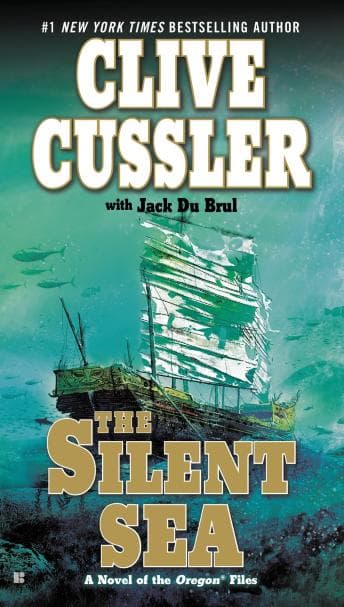

So I was up at 2 AM last Saturday, way past the point where my thesis code was going to compile into anything useful, and I figured - you know what, let me just fire up something fun while I reorganize my board game shelf. (Yes, I reorganize it by BGG rating. No, I will not apologize.) Grabbed The Silent Sea because I'd been meaning to work through the Oregon Files series, and honestly? Cussler and Du Brul delivered exactly the kind of globe-trotting, pulpy adventure I needed to justify ignoring Dr. Patel's email about my "revised timeline."
The Oregon Is Basically a Floating D&D Airship and I'm Here For It
Let me explain the Oregon to the uninitiated: it's a covert spy ship disguised as a rusted tramp freighter, packed with military-grade weapons, cutting-edge tech, and a crew of mercenary operators led by Juan Cabrillo. It's basically if someone built a Level 20 Artificer's dream vessel and then cast Disguise Self on it. The ship itself is almost a character, and in The Silent Sea, you get those classic sequences aboard it - weapons hot, hull taking damage, Cabrillo barking orders while everything goes sideways.
What sets this particular entry apart from some of the earlier Oregon books is the dual timeline structure. The prologue hooks you with five brothers in 1941 discovering something weird in a shaft on an island off the Washington coast - and then Pearl Harbor interrupts everything. That historical thread eventually connects to an ancient Chinese expedition (we're talking pre-Columbus exploration here), and there's this curse element that gives the whole thing an almost Indiana Jones flavor. It's not Sanderson-level world-building - let's be real, Cussler's playing a different game entirely - but the layering of historical mysteries on top of modern action is the engine that makes these books work, and Du Brul's co-writing influence tightens the plotting compared to some of the looser solo Cussler entries.
The progression is satisfying. You start with the historical puzzle, Cabrillo picks up a thread, pulls it, and suddenly you're bouncing between Argentina, the Antarctic, and back to that Pacific Northwest island. The pacing runs hot - this is 11 hours that moves like 7. If you've read other Cussler/Du Brul collaborations, you know the formula: mystery, investigation, escalation, explosive finale. And that finale here? It goes hard. The last couple hours ramp up the action sequences significantly, and it sticks the landing better than some entries in the series that kind of fizzle at the end.
Scott Brick vs. Steven Pacey: An Unfair But Inevitable Comparison
Look, I measure all narrators against Steven Pacey because I'm unreasonable and I know it. Scott Brick is a completely different beast - where Pacey gives you theatrical character work with voices so distinct you forget it's one guy, Brick is more of a commanding storyteller. His strength is pacing and energy. During the action sequences aboard the Oregon, he ratchets up the intensity in a way that genuinely kept me sorting Catan expansions faster. His Cabrillo has this confident, slightly weathered quality that fits the character well.
His accent work is solid if not spectacular - he differentiates the international cast enough that you're never confused about who's speaking, which in a book with American, Argentine, and Chinese characters is no small feat. He's particularly good in the quieter reflective moments between set pieces, where a lesser narrator might just coast. Brick keeps tension in those scenes. He actually does a similar kind of steady, controlled narration work in Without Fail, another action-heavy title where his pacing instincts carry the material even when character voices blur together a bit.
My one gripe? He doesn't quite have the range to make the secondary crew members feel truly individual. Max Hanley and Linda Ross and the rest of the Oregon team - they're distinct enough on the page through dialogue and action, but Brick's vocal differentiation between them is more subtle than I'd prefer. It's not a dealbreaker. But if you're coming from a full-cast production or a Pacey-level performance, you'll notice it.
Who's Rolling Initiative on This One
If you like your adventure fiction the way my D&D group likes our campaigns - fast, globe-spanning, historically flavored, and not too worried about literary pretension - this is your book. It's beach-read energy in audio form, and I mean that as a compliment. Cussler never pretended to be literary fiction, and Du Brul's contributions sharpen the plotting without losing the fun.
Skip it if you need deep character development or if the idea of a secret spy ship with hidden weapons feels too over-the-top. (But honestly, if that sounds too over-the-top, I don't think we can be friends.)
If you don't like info-dumps, this isn't for you (but you're wrong). There are chunks of historical exposition about Chinese exploration and Argentine military history that some listeners will love and others will zone through. I was solidly in the love camp.
I Read This Instead of Writing My Thesis (Worth It)
This isn't going to change your life. It's not going to make you rethink the genre. But it's 11 hours of expertly paced adventure with a narrator who knows exactly how to deliver this kind of material, and sometimes that's exactly what you need at 2 AM when your code won't compile and your advisor's disappointment exists only as an unread email. My board game shelf looks great now, and I have a new appreciation for pre-Columbian Chinese naval theory. Win-win.