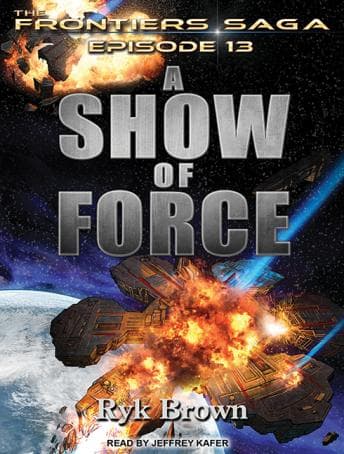

How deep into a series do you have to be before you stop asking yourself "should I keep going?" and just accept that this is your life now?
Thirteen books. I'm thirteen books into the Frontiers Saga, and I hit that point somewhere around book five. This is just what I do now. I listen to Jeffrey Kafer narrate Captain Scott's increasingly absurd tactical situations while I pretend to debug my procedural generation code. Dr. Patel would be thrilled to know that instead of working on my thesis, I've been mentally calculating jump drive physics and wondering whether the Aurora's shield harmonics could be modeled as a Markov chain. (They can't. I checked. At 2 AM. Instead of writing my lit review.)
The Frontiers Saga Finally Hits Its Stride at Warp Speed
So here's the thing about Show of Force that surprised me - it's book 13 in a long-running military sci-fi series, and it should feel tired by now. The formula is pretty established: Aurora jumps in, things go sideways, Captain Scott makes a call that's either brilliant or suicidal, rinse, repeat. But Ryk Brown does something genuinely interesting here. The premise shifts from "scrappy underdogs fighting the Jung" to "okay, we're actually winning now, and winning is complicated." The Aurora is carving out a 20 light-year sphere of safety around Earth, systematically clearing Jung forces from the core systems. It's a liberation campaign. And - this is where it gets good - not everyone wants to be liberated.
That political wrinkle is what kept me hooked. Brown's been building toward this for several books, and it pays off here. Some worlds have accommodated Jung rule. Some have collaborated. Some genuinely prefer the stability of occupation to the chaos of freedom. It's the kind of gray-area world-building that I live for - not Sanderson-level world-building, let me be honest, but for military sci-fi? The last time I felt this kind of slow-burn political payoff in a sci-fi series was reading MaddAddam, though Brown is working in a completely different register - less literary apocalypse, more boots-on-the-ground consequence. The progression is satisfying. You can feel Brown's confidence growing as a writer. The tactical sequences are tighter, the stakes feel real, and when the description promises "the death of a trusted friend," it actually lands with weight because you've spent 13 books with these people.
Jeffrey Kafer is the Reliable Party Member Who Never Misses a Session
Look, Kafer isn't Steven Pacey. Steven Pacey walked so other narrators could run, and Kafer is solidly in that "dependable jogger" category. He's narrated every single Frontiers Saga book, and there's real value in that consistency. You know exactly what you're getting. His Captain Scott voice is locked in. His pacing during combat sequences - and there are a LOT of combat sequences - keeps the energy up without turning into breathless chaos. He's the narrator equivalent of a fighter who always shows up to the session with their character sheet filled out correctly. Not flashy. Never lets you down.
That said, I genuinely can't tell you much about his character differentiation because after 13 books, the voices have kind of melted into a familiar soup in my brain. I know who's talking because of context and cadence more than distinct vocal choices. For a series this deep, that's... fine? You're not picking this up as your first Kafer experience. You're here because you've been here.
Who's Rolling Initiative and Who Should Sit This One Out
If you haven't read the first twelve books, absolutely do not start here. This isn't a standalone. This isn't even a good entry point. If you're genuinely new to military sci-fi and want a place to actually start, Greylorn is a much shorter on-ramp - old school, a little rough around the edges, but it scratches the same itch for lone-ship-against-impossible-odds tension. It's book 13 and it acts like it - characters reference past events, alliances from earlier books matter, and you'll be completely lost without the foundation.
But if you're already invested? This is one of the stronger entries. My D&D group would love this - it's basically a military campaign with complications, resource management, and the occasional NPC who refuses to cooperate with your carefully laid plans. The "not every world wants liberation" angle gives it a dimension that earlier books sometimes lacked.
I listened to most of this during a marathon board game night where my friends were playing Twilight Imperium and I was "thinking about my next move" (I was not thinking about my next move). 13 hours is a solid chunk, but for Frontiers Saga standards it's pretty middle of the road. If you're doing this on 1.25x like I eventually switched to, you'll burn through it on a weekend.
The one thing I'll flag: that description mentions sexual content alongside the violence and language, but this is still fundamentally a military space opera. Don't go in expecting anything heavy on that front.
Add It to the Campaign Log
Thirteen books deep and I'm still queueing up the next one. That's either a recommendation or a cry for help. Probably both. I read this instead of writing my thesis, and I regret nothing. If you're riding the Frontiers Saga wave, Show of Force is the payoff book you've been grinding toward. If you're not? Start at book one. I'll be here when you catch up. Still not graduating.