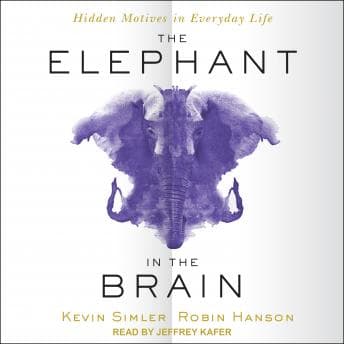

I was making dal makhani at 10 PM on a Tuesday — the kind of elaborate, slow-cooked version my mother would approve of — when Simler and Hanson casually dismantled every comforting story I tell myself about why I do the things I do. Stirring a pot of lentils while two academics explain that your charitable donations are basically a status flex? Humbling. My therapist would have thoughts.
Here's what The Elephant in the Brain argues, stripped to its bones: we are liars, and we're so good at it that we've fooled ourselves first. Not in a dramatic, soap-opera way. In a boring, everyday, "I'm going to this networking event because I care about the community" way. The book's central thesis is that human behavior is driven by hidden motives — signaling, status-seeking, coalition-building — and that our conscious explanations are mostly PR campaigns running after the fact.
Your Altruism Is a Press Release (And So Is Mine)
What makes this book land differently from your average "humans are selfish" pop-psychology fare is the structural ambition. Simler and Hanson don't just say "people have hidden motives" and call it a day. The first half builds the theoretical scaffolding — body language, laughter, conversation norms — and then the second half takes that framework and runs it through institutions: education, medicine, charity, religion, art, politics. Each chapter is basically a case study in collective self-deception.
The education chapter hit me particularly hard. Their argument isn't just that school is partly about signaling (that's old news since Bryan Caplan). It's that we've built an entire institutional apparatus — attendance requirements, grading curves, credentialing — that makes more sense as a sorting and compliance mechanism than as a learning system. And the uncomfortable part? We all kind of know this. We just don't say it. That's the elephant.
Compared to something like Jonathan Haidt's The Righteous Mind, which focuses on moral intuitions and post-hoc rationalization in political contexts, Simler and Hanson cast a wider net. Haidt wants to explain why we disagree. These two want to explain why we do anything — and why we lie about it. It's more cynical, sure, but it's also more architecturally interesting. Where Haidt gives you one lens, this book gives you a toolkit.
Where the Framework Gets Wobbly
But here's where I found myself asking: does the argument prove too much? The research actually shows that hidden motives exist and are powerful — no argument there, I've built a career on that premise. But Simler and Hanson have a habit of presenting their evolutionary-signaling explanation as the explanation, when often it's an explanation competing with several others. The medicine chapter, for instance, argues that we consume more healthcare than is medically optimal because healthcare is partly about showing care and receiving attention. Okay. Psychologically, this tracks to some degree. But the chapter doesn't seriously grapple with the fact that people also overconsume healthcare because they're scared, because the system is opaque, because information asymmetry is real. The signaling explanation does work — it's just not the whole story, and the book sometimes writes like it is.
This is a fascinating case study in what happens when smart people fall a little too in love with a single framework. Hanson comes from economics, and you can feel the economist's instinct to find one elegant model that explains everything. Real human psychology is messier than that. The protagonist here — and yes, I'm treating the book's thesis as a character, fight me — exhibits classic confirmation bias. Every example is marshaled in support; counterevidence gets a footnote if it gets anything at all. I've seen this same true-believer energy in books that are far less rigorous — Our Occulted History is basically what happens when a single framework gets zero pushback and the author just keeps going, which made me appreciate that Simler and Hanson at least have the receipts for most of their claims.
That said? The framework is genuinely useful. I've been thinking about it for days. It's the kind of book that rewires your pattern recognition even when you disagree with thirty percent of it.
Jeffrey Kafer Does the Job (No More, No Less)
Kafer's narration is clean and professional — a good match for the material's academic-but-accessible register. This isn't a book that needs vocal fireworks. It needs clarity, measured pacing, and the ability to make dense argumentative chapters feel like a conversation rather than a lecture. He delivers that. I wouldn't call the performance memorable in itself, but it never gets in the way, which for a 10-hour nonfiction listen is genuinely important. I bumped it to 1.25x during the institutional chapters in the second half — not because they drag, but because the argument becomes more repetitive in structure (here's the official story, here's the hidden motive, repeat), and a slight speed increase kept my attention locked.
Who Needs to Hear This (And Who'll Throw Their Phone)
If you've read Kahneman, Haidt, or Robert Wright's The Moral Animal and want the next uncomfortable step — the one that applies self-deception theory to institutions, not just individuals — this is your book. If you work in education, healthcare, or nonprofits, prepare to feel personally attacked in at least one chapter. If you need your nonfiction to be rigorously balanced with equal weight given to counterarguments, you'll be frustrated. Simler and Hanson are advocates, not arbiters.
My Clinical Assessment
Three stars for the second half's repetitive structure and occasional overreach. Four and a half for the sheer usefulness of the core idea. Split the difference. This is the kind of book that makes you annoying at dinner parties because you keep saying "but what's the hidden motive?" — and honestly, that's a compliment. My dal turned out great, by the way. Hidden motive: I wanted to prove I could make it better than the restaurant version. See? The framework works.









![Steve Jobs [unabridged audiobook] audiobook cover](/_next/image?url=https%3A%2F%2Fcovers.audiobooks.com%2Fimages%2Fcovers%2Ffull%2F9788499923406.jpg&w=1920&q=75)