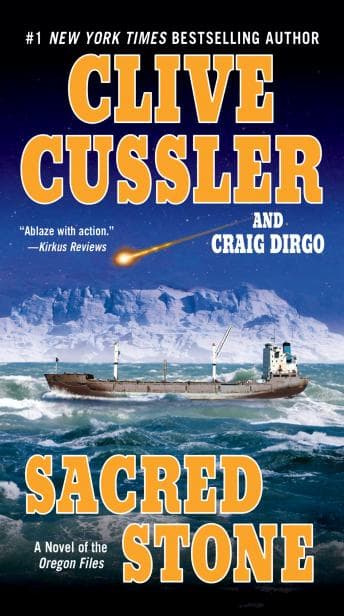

Sacred Stone is a popcorn action novel that knows exactly what it is and doesn't pretend otherwise.
I was three hours deep into this at 2 AM, telling myself I'd stop after one more chapter and get back to my thesis proposal. (I did not get back to my thesis proposal.) The Oregon Files series is basically what happens if you gave a D&D party an unlimited budget, a spy ship disguised as a rust bucket, and told them to save the world. Juan Cabrillo is the charisma-maxed party leader, and his crew on the Oregon fills every archetype you'd want at your table — the tech wizard, the weapons specialist, the smooth talker. It's not subtle. It doesn't need to be.
A Radioactive MacGuffin and Two Factions Walk Into a Plot
The setup here is pure pulp adventure: a 50,000-year-old radioactive meteorite found in a Greenland cave, two opposing groups racing to grab it — Muslim extremists with a stolen nuke on one side, a billionaire industrialist with genocide-level ambitions on the other. Cabrillo and the Oregon crew have to thread the needle between both. It's a dual-threat structure that keeps the pacing moving because you're always cutting between storylines before anything drags.
But here's the thing — this is a Cussler-Dirgo joint, not pure Cussler. You can feel the difference. The prose is leaner, almost utilitarian in places. The world-building is functional rather than immersive. Where Cussler's solo work lingers on hardware descriptions and historical detail with a kind of loving obsession (the man clearly spent weekends in maritime museums), Dirgo keeps things clipped and mission-focused. Some listeners love that efficiency. I found myself wanting a little more texture, more of those random historical asides that make Cussler feel like Cussler. The plot moves fast — maybe too fast in spots — burning through location changes and character introductions at a pace that sometimes feels like reading a mission briefing rather than a novel.
At 12 hours, it's a reasonable commitment. Not the 40-hour Sanderson marathon I usually sign up for, but decent enough for a week of commuting and late-night coding sessions.
J. Charles: The Narrator Debate
Okay, so J. Charles is polarizing, and I think I understand why. He differentiates characters through accent shifts and cadence changes — his Cabrillo has this steady, determined gravitas to it, and he handles the urgency of action sequences well enough that the set pieces land. When the Oregon crew is executing an operation, Charles conveys the tempo and the stakes.
But — and this is where it gets tricky — there's a flatness to his baseline delivery that I noticed around hour 6. During the connective tissue between action beats, when you're getting exposition or character downtime, his energy dips. It's not monotone exactly, more like... consistent in a way that starts to blur. Compare that to someone like Steven Pacey, who could make a grocery list sound like a blood oath, and you feel the gap. Pacey walked so other narrators could run, and Charles is jogging here. Competent jogging, but jogging.
Some people called the narration boring and dull — I wouldn't go that far. I'd say it's workmanlike. It serves the story without elevating it. For a pulp action novel, that's... fine? You're not here for a transformative vocal performance. You're here because a ship full of spies is trying to stop two different apocalypses simultaneously.
Who Should Queue This Up (And Who Should Pass)
If you're already invested in the Oregon Files series, this is a solid second entry. If you love Cussler's Dirk Pitt books and want that same action-adventure energy with a slightly different crew, you'll find it here. My D&D group would love the ensemble dynamics — it really does read like a well-run party tackling a complex scenario with multiple objectives.
But if you're the kind of listener who needs deep character development or Sanderson-level world-building, this isn't your book. The characters are archetypes serving the plot, not the other way around. And if you're narrator-sensitive — if a voice that doesn't quite pop during slower sections will pull you out — maybe sample a chapter first. The listener reviews on this one are genuinely split, and I get both sides.
I wouldn't put it on as background audio either. There are enough faction switches and location jumps that if you zone out for ten minutes, you'll come back confused about which group of bad guys is doing what in which country.
Roll Initiative and Move On
Sacred Stone is a fast, competent action-adventure audiobook that does exactly what the tin promises. No more, no less. I listened to it instead of writing my thesis, and while I don't regret it, I'm also not going to be quoting passages to strangers at conventions. It's the literary equivalent of a solid action movie you watch on a Tuesday night — entertaining, forgettable in the details, satisfying in the moment. Worth your time if the genre is your thing. Just don't expect the magic system to be chef's kiss — there's no magic system. Just guns, gadgets, and a really cool spy ship.