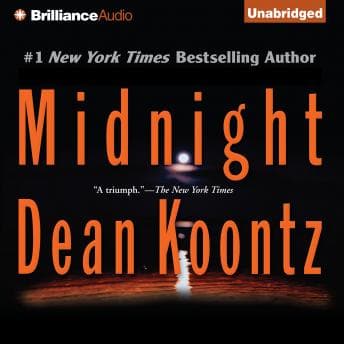

I was making chana masala at midnight — yes, I see the irony — when the audiobook hit a scene that made me put down my spatula and just stand there in my kitchen, staring at nothing. Chrissie Foster, eleven years old, is hiding under a porch while her own parents hunt her through the dark. Not metaphorically hunt. Actually hunt. And I found myself asking: why does Koontz make the child the most psychologically intact character in the entire book?
Because he does. And it works.
The Town That Failed Its Own Thought Experiment
Here's what fascinated me about Midnight from a behavioral standpoint. The premise is essentially: what if you could "upgrade" human beings — eliminate emotional pain, fear, weakness — and an entire small town became the test population? Thomas Shaddack, the tech-mogul antagonist, is running what amounts to forced conversion therapy on Moonlight Cove's residents, turning them into something he calls the New People. Emotionless. Efficient. "Improved."
The protagonist exhibits classic grandiose narcissism with a god complex — Shaddack genuinely believes he's saving humanity by stripping away the messy bits. The research actually shows that people who pursue radical control over others almost always frame it as benevolence. Koontz gets this right. Shaddack isn't twirling a mustache; he's convinced he's the hero of his own story. That's what makes him unsettling rather than cartoonish.
But here's where it gets psychologically interesting. The "upgraded" residents don't stay rational and controlled. They regress. They become feral, animalistic, losing themselves to pure sensation because — and my therapist would have thoughts about this — you can't surgically remove human emotion without the whole architecture collapsing. Koontz wrote this in 1989, and he accidentally predicted what every trauma researcher now knows: suppression doesn't eliminate feelings, it distorts them into something worse. I saw similar psychological unraveling in Fairy Ring, where the horror also stems from what happens when human boundaries get erased.
This is a fascinating case study in what happens when you treat the human psyche like software to be patched.
Four Strangers, One Shared Survival Response
The four-person ensemble — Tessa, Sam, Harry, and Chrissie — is structured almost like a group therapy intake. Each one represents a different coping mechanism. Sam Booker, the FBI agent, is the detached professional using work as emotional armor (his failing relationship with his teenage son is textbook avoidant attachment). Tessa Lockland arrives driven by grief over her sister's death, channeling loss into investigation because sitting still with the pain isn't an option. Harry Talbot, the wheelchair-bound veteran watching the town from his window, is the observer who's been forced into passivity by his body but refuses it mentally.
And then there's Chrissie. Eleven years old, watching her parents become something inhuman, and she processes it by narrating her own survival as if she's the heroine in an adventure novel. That's not cute authorial whimsy — that's a textbook dissociative coping strategy in children facing overwhelming threat. Whether Koontz intended that level of psychological accuracy or stumbled into it, it doesn't matter. It lands.
What makes this character compelling is her refusal to be a victim archetype. She's resourceful and funny and terrified, and the book gives her enough internal monologue that you understand she's not brave because she doesn't feel fear. She's brave because she's decided fear doesn't get to win.
J. Charles and the Narrator Problem
Okay. Let's talk about the performance. J. Charles brings genuine energy to the reading — he's not sleepwalking through 15 hours, and he injects humor into Chrissie's sections that keeps the relentless darkness from becoming suffocating. When he's doing Chrissie's internal adventure-story narration, his voice lifts with this almost conspiratorial amusement that matches her coping mechanism perfectly.
But — and this is a significant but — the performance is uneven. The more intense emotional beats sometimes feel rushed rather than inhabited, like Charles is narrating at the characters instead of through them. Sam Booker and Tessa don't sound distinct enough from each other in dialogue-heavy scenes, which matters when you're relying on voice alone to track who's speaking. For a 15-and-a-half-hour listen, that inconsistency adds up. I found myself rewinding a few times during the middle third, which dragged more than the opening or the finale.
Psychologically, this doesn't track as a bad narration — it tracks as a mismatched one. Charles's high-energy style suits the action and Chrissie's sections but underserves the quieter character moments where Koontz is actually doing his best writing.
Who Gets the Most Out of This
If you're a Koontz completist, you probably already own this. If you're coming in fresh: this is 1989 Koontz, which means it's leaner and meaner than his later work, less prone to philosophical tangents, more willing to let terrible things happen to people you like. That same willingness to put beloved characters through hell shows up in Lightning Strike, which doesn't pull punches either. The horror elements are genuinely disturbing — the regression scenes read like body horror filtered through behavioral psychology.
Skip it if bad character differentiation in narration is a dealbreaker for you, or if you need fast pacing from page one (the first few hours are setup-heavy). But if you're interested in a horror novel that's secretly asking "what makes us human, and what happens when someone tries to edit the answer?" — this one's got more going on under the surface than its pulp packaging suggests.
I finished the chana masala, by the way. Overcooked it. Worth it.
Case File: Closed, With Reservations
Koontz understood something about human nature here that a lot of horror writers miss: the scariest transformation isn't the physical one. It's watching someone you love decide that feelings are weakness. That the cure for suffering is to stop being a person. Midnight isn't his most polished book, and this audiobook version isn't the ideal way to experience it — but the psychological foundation is solid enough that I kept thinking about it on my morning jog the next day. And the day after that.
The narration knocks it down a peg. The ideas keep it standing.