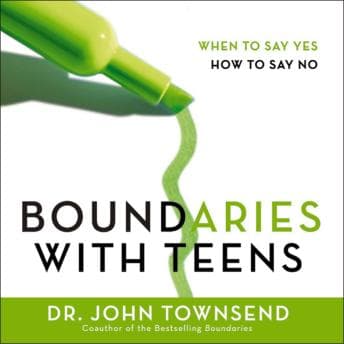

My parents never read a parenting book in their lives. They raised me on instinct, Korean immigrant pragmatism, and the occasional wooden spoon. And you know what? I turned out fine. Mostly. So when I picked up Boundaries with Teens during a late-night hotel stay in Austin - couldn't sleep, client pitch in the morning, brain wouldn't shut off - I approached it with my usual skepticism toward parenting advice written by people with PhDs.
Bottom line: This is solid, practical guidance wrapped in 3 hours too much padding. Dr. Townsend knows his stuff, but he takes the scenic route getting there.
What My Parents Did Without the TED Talk
Here's the thing that kept hitting me throughout this listen - Townsend is essentially codifying what effective parents have done forever. Set clear expectations. Follow through on consequences. Love the kid while hating the behavior. My mom didn't need a counseling degree to understand that when I came home past curfew, there would be consequences. She just did it.
But here's where Townsend earns his keep: he explains why these things work. The psychology behind adolescent brain development, the difference between punishment and natural consequences, how to maintain relationship while enforcing rules - this stuff is genuinely useful. I found similar relationship dynamics explored in Love and Respect, though Townsend's focus on teens makes the power dynamic more nuanced. For parents who didn't grow up with clear boundary models, or who are dealing with situations more complex than "be home by 10," the framework here is worth understanding.
The biblical integration is present but not overwhelming. If you're coming from a faith perspective, you'll appreciate it. If you're not, it's easy enough to translate the principles into secular terms. Townsend isn't preaching - he's counseling.
The 8-Hour Problem
Look, I've consulted with enough companies to recognize when someone is stretching 3 hours of content into an 8-hour deliverable. Townsend does this. The core concepts - empathy before enforcement, letting natural consequences do the teaching, the difference between controlling and influencing - could be communicated in half the time.
My 2.0x speed helped, but even then, there's repetition. The same principles get illustrated with slightly different scenarios. The same warnings about being too harsh or too permissive get repeated chapter after chapter. If you've worked with enough dysfunctional organizations (and I have), you recognize the pattern: solid intellectual property, padded execution.
Skip around if you need to. Chapters on specific issues - dating, school performance, substance abuse - work better as reference material than sequential listening.
J. Charles Does the Job
The narration is... fine. J. Charles reads clearly, keeps a steady pace, and doesn't get in the way of the content. That's exactly what you want for a book like this. No dramatic character voices needed. No theatrical flourishes. Just a calm, authoritative delivery that matches Townsend's counselor-in-your-living-room tone.
I've heard worse. I've heard better. For a practical parenting guide, competent narration is sufficient, and that's what you get.
Who Should Listen (And Who Should Skip)
If you're a parent of a 12-16 year old and you're currently losing battles you didn't even know you were fighting - this is worth your time. Especially if you came from a household where boundaries were either non-existent or enforced through fear. Townsend gives you a third way.
If your kid is already 17 and you've been consistent with boundaries all along? Skip it. You've already figured it out.
If you're a youth pastor, school counselor, or anyone else working with teens professionally? Solid framework. The language around "empathy plus limits" gives you vocabulary for conversations with frustrated parents.
Jenny and I don't have kids yet. (Her choice. She says I'd try to optimize bedtime routines with a spreadsheet. She's not wrong.) But I listened anyway because half my startup clients are distracted parents, and understanding what's happening at home helps me understand what's happening in the boardroom. That same impulse to understand underlying patterns drove me through Girl, Wash Your Face - different audience, similar need to decode what makes people tick.
The Consultant's Assessment
I've seen the principles in this book work - not with teens, but with employees. The psychology is the same. Clear expectations, consistent consequences, maintained relationship. Townsend would probably hate that comparison, but it's true.
The book delivers value. It just delivers it inefficiently. At 4 hours, this would be a must-listen. At 8+ hours, it's a strategic skim. Use the chapter titles, jump to your specific pain points, absorb the framework, and move on.
My parents would've never listened to this. But they would've nodded along if they had.