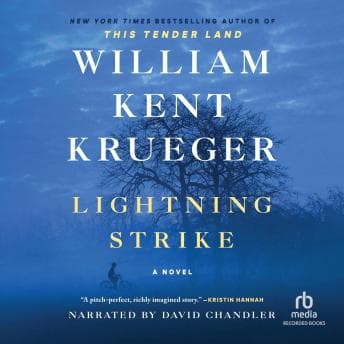

What happens when the man who taught you about justice becomes the one investigating something that doesn't add up?
I finished this one at 0200, sitting on my back porch with Ranger at my feet and a bourbon I'd forgotten to drink. The ice had melted completely. That's the kind of book this is—the kind that makes you forget about everything else.
When a Kid Sees What Adults Won't
Let me cut to the chase: Krueger nails something here that most mystery writers completely botch. The relationship between Cork and his father Liam isn't some Hollywood father-son bonding exercise. It's complicated. Liam's the sheriff, which means he's got to follow evidence even when his gut screams otherwise. Cork's twelve, old enough to sense when adults are lying to themselves but too young to understand why they do it.
The discovery of Big John Manydeeds hanging at Lightning Strike—that scene hit me harder than I expected. I've seen death. I've processed it in ways civilians shouldn't have to. But there's something about a kid finding a man he looked up to like that. Krueger doesn't sensationalize it. He lets the weight of it sit there, and you feel Cork's world crack open.
This is 1963 Minnesota, and the tensions between the white townspeople and the Ojibwe community aren't subtle. They're the kind of long-simmering conflicts I've seen play out in different forms across three continents. Different uniforms, same tribalism. Krueger clearly did his homework on this period, and he doesn't let anyone off the hook—not the obvious bigots, not the well-meaning liberals, nobody.
Chandler's Voice Fits Like Worn Leather
I've listened to a lot of narrators phone it in on mystery audiobooks. Chandler isn't one of them. His voice has this weathered quality that fits the northern Minnesota setting perfectly—like someone who's spent winters actually being cold, not just reading about it. The subtle shifts between characters work because he's not doing cartoon voices. Cork sounds young without being annoying. Liam sounds tired in the way fathers of that era sounded tired—carrying weight they'd never name.
The pacing of his delivery matches Krueger's prose. This isn't a thriller with car chases and explosions (Linda would be disappointed). It's a slow burn that rewards attention. I tried bumping it to 1.25x during a drive to Houston and found myself backing off. Some books demand you stay at their pace.
The Epilogue Will Get You
I don't cry at books. I didn't cry at this one either. But I sat very still for a long time after the epilogue ended. There's a gut-punch there that I won't spoil, but it connects everything—the summer of '63, what Cork becomes, why this story matters decades later. If you've ever looked back at a single summer that changed everything about how you saw the world, you'll understand.
For those who've read the Cork O'Connor series, this apparently enriches the whole thing. I came in cold and didn't feel lost. If anything, now I want to go forward and see what that twelve-year-old becomes.
Who Should Deploy This One
This is for readers who want their mysteries served with moral complexity. If you need action every chapter, look elsewhere. If you want a book that respects your intelligence and doesn't wrap everything in a neat bow, you're in the right place.
Fans of literary crime fiction—think Craig Johnson's Longmire series or Dennis Lehane's earlier work—will feel right at home. Flicker in the Dark works similar territory: small-town secrets and the kind of moral ambiguity that doesn't resolve cleanly. Parents with complicated relationships with their own fathers might want to have tissues nearby. Not that I'd know anything about that.
Skip this if you can't handle slow pacing or if you need your protagonists to be unambiguously heroic. Liam O'Connor is a good man trying to be a good sheriff in a town that doesn't always want good. That's messier than some readers want.
Debrief Complete
Worth your time? Krueger delivers a prequel that stands completely on its own while apparently adding depth to a long-running series. Chandler's narration is the kind of quality that makes you forget you're listening to a performance. At just under twelve hours, it's a solid commitment, but it earns every minute.
Ranger approved this one. He didn't move from his spot by my chair until it was over, and that dog has opinions about my listening choices.
This is the kind of story that reminds you why you started reading mysteries in the first place—not for the puzzle, but for the truth about people it uncovers along the way.