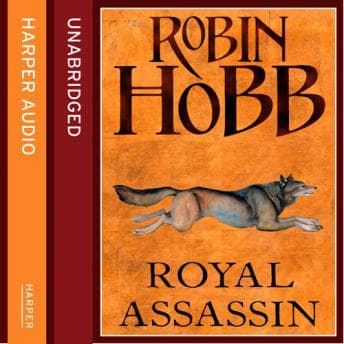

Everyone told me Paul Boehmer's narration was either "immersive and excellent" or "painfully monotonous." Thirty hours later, I'm here to tell you both camps are right, and that's the most frustrating thing about this audiobook.
I started this one on a late shift at the library, shelving returns in the back room with the lights dimmed because our fluorescents were flickering again (very on-brand for me, I know). And something about Boehmer's voice in that setting just worked. Fitz's first-person narration has this confessional, almost diary-like quality, and Boehmer leans into that — his delivery feels like someone recounting their worst memories to you across a table, not performing them. When Fitz is alone with Nighteyes, when it's just the Wit-bond and the ache of it, Boehmer captures something genuinely intimate.
But then a court scene hits, and I'm yanked out.
The Accent That Can't Decide Where It Lives
Look, I'm not British, so I don't carry the specific frustration some UK listeners have with this performance. But even I noticed the voice slips. Boehmer aims for a British upper-class register for the Six Duchies court — which makes sense, it's a feudal system, there's royalty involved — but when characters get drunk or aggressive, his accent slides into something that sounds distinctly Southern American. It's not a choice that maps onto any worldbuilding logic. It's just... inconsistent. And in a 29-hour audiobook, inconsistency compounds. By hour fifteen, I was tracking it, which means I wasn't tracking the story, which means the narration was failing at its one job.
His pronunciation of names is another sticking point. I won't pretend I caught every mispronunciation — I haven't read the print editions recently enough to be certain on all of them — but there were moments where a name came out differently than it had two chapters ago, and that's the kind of thing that erodes trust between narrator and listener.
Robin Hobb Wrote a Slow Knife and Boehmer Mostly Lets It Cut
Here's the thing, though: the source material is extraordinary. Royal Assassin is a book about powerlessness. Fitz is supposedly this trained killer, this weapon of the crown, and Hobb spends 29 hours systematically stripping him of every tool, every ally, every illusion of control. Shrewd is wasting away. Verity leaves on what feels like a suicide mission. Regal is doing his snake-in-silk-robes thing. And Fitz just... endures. It's brutal. Not in a gore way — this understands that horror isn't about gore, it's about dread. Dan Simmons taps that same slow-building existential terror in Terror: A Novel — men trapped by forces larger than themselves, powerlessness dressed up as adventure. And Hobb writes political dread like few fantasy authors can.
The Nighteyes relationship is where this audiobook genuinely sings. Boehmer gives the wolf's Wit-communications a slightly different cadence — not a "voice" exactly, more of a shift in rhythm, a loosening. It captures the way Nighteyes thinks in images and instinct rather than words. When Fitz has to choose between his duty to Shrewd and his bond with Nighteyes, Boehmer lets the silence do work. The narrator commits. That's rare.
But the pacing. Oh, the pacing. Hobb's prose is deliberately slow — it's a feature, not a bug — but Boehmer's delivery sometimes matches that slowness beat for beat, and in audio form, slow plus slow equals monotonous. There were stretches in the middle third where I genuinely considered bumping the speed up. I held at 1.25x and it helped without losing the emotional texture, but at 1.0x, entire chapters felt like wading through wet sand.
Who Gets an Invitation to Buckkeep
If you love character-driven fantasy that prioritizes political maneuvering and emotional devastation over action setpieces, this is your book. Full stop. Shirley Jackson walked so Robin Hobb could run — different genres, sure, but the same commitment to making you feel trapped inside a protagonist's deteriorating situation.
If you need your fantasy to move, if you want battle sequences and magic systems with hard rules, you'll be checking the progress bar by hour ten. And if inconsistent accents are a dealbreaker for you, know that going in.
My podcast listeners are going to love this recommendation with the caveat: commit to 1.25x speed, commit to focused listening, and commit to the slow burn. This is not a background audiobook. This is a sit-down-and-suffer audiobook. And I mean that as a compliment.
The Kind of Pain You Sign Up For
I finished this at 1 AM, sitting on my apartment floor with Shirley asleep on a stack of Shirley Jackson paperbacks (she does this on purpose, I'm convinced). And I was genuinely angry — at Regal, at the court, at Fitz's stubborn loyalty to people who don't deserve it. That's the mark of a story that's doing its job. Boehmer doesn't always serve it perfectly, but he serves it well enough that when the knife twists, you feel it. A flawed performance of a remarkable book. The book earns the credit. The narration... mostly doesn't get in the way.