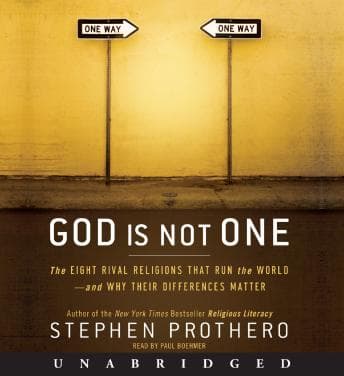

I was three hours into this on a Saturday morning lakefront walk with Denise when she finally pulled out one of my earbuds and said, "You've been mumbling about Confucianism for twenty minutes." She wasn't wrong. Prothero had gotten so deep into the distinction between ren and li that I was basically teaching an invisible class to the joggers passing us on the path.
Here's the thing about this book that grabbed me immediately: Prothero's central argument is the kind of take that would start a fight at a faculty meeting, and I mean that as a compliment. He's pushing back hard against the Huston Smith "all religions are climbing the same mountain" framework - the one that sounds generous and inclusive but actually, Prothero argues, flattens every tradition into a vaguely Protestant shape. Instead, he structures each chapter around a different problem that each religion identifies as humanity's fundamental crisis. Islam addresses pride and its solution is submission. Buddhism tackles suffering through awakening. Christianity focuses on sin and offers salvation. It's a clean framework, almost too clean sometimes, but it gives you genuine purchase on traditions that most Western listeners - myself included - tend to blur together.
The Teacher Who Refuses to Simplify
What I kept coming back to is that Prothero writes like the best kind of professor - the one who respects you enough to say "no, actually, you're wrong about that." He's not interested in making you feel comfortable. The chapter on Yoruba religion alone is worth the listen because most comparative religion books either skip it entirely or treat it as an anthropological curiosity. Prothero gives it structural weight alongside Christianity and Islam. Same with his decision to include atheism as the eighth "rival" - it's provocative, maybe a little cheeky, but it forces you to think about what qualifies as a religious worldview in the first place.
The Confucianism and Daoism chapters hit differently for me because I teach American literature, and my students constantly ask why we bother reading Emerson's transcendentalist stuff. Prothero draws these connections between Eastern and Western philosophical traditions without making them sound like they're secretly the same thing. He keeps the differences sharp. The prose deserves to be savored - Prothero writes with the confidence of someone who's taught this material for decades and knows exactly where the common misunderstandings live.
Now, is the framework a little reductive? Sure. Eight chapters, eight religions, each with one problem and one solution - it's a pedagogical device, and like all pedagogical devices, it sacrifices some complexity for clarity. The Buddhism chapter, for instance, compresses a tradition with wildly divergent schools into a single problem-solution arc. My students would recognize the move. It's what you do when you've got 45 minutes and 30 teenagers who haven't done the reading. But Prothero is upfront about the simplification, which counts for a lot.
Paul Boehmer Does the Quiet Work Right
Boehmer's narration is the kind I appreciate most - restrained, clear, and smart about emphasis. This is a book dense with foreign terms across eight different linguistic traditions, and he handles them with what sounds like genuine care rather than the performative confidence some narrators bring to unfamiliar words. He doesn't try to dramatize the material. He trusts it. The narrator understands that pause is punctuation - and in a book this idea-heavy, knowing when to let a sentence land before moving to the next one is everything.
At fourteen and a half hours, this is a commitment. I spread it across about two weeks - walks, late-night grading sessions, one very long wait at the DMV. It rewards sustained attention but doesn't punish you for coming back after a break, because Prothero's chapter structure means each religion gets its own self-contained argument.
Who Gets the Assignment (and Who Gets a Pass)
If you loved Karen Armstrong's work but always felt she was a little too eager to find common ground between traditions - this is the corrective. If you're looking for a devotional text or spiritual comfort, wrong book. This is comparative religion as intellectual exercise, not interfaith kumbaya. My students would hate this. I love it. The Christianity chapter in particular made me think back to my time with Case for Christ, which approaches the faith from a completely different angle - investigative rather than comparative - and the contrast actually sharpened my appreciation for what Prothero is doing here.
One caveat: if you're deeply committed to any single tradition covered here, you might find Prothero's single-chapter treatment frustratingly brief. He's painting with broad strokes by design, but broad strokes can feel dismissive when it's your tradition being summarized.
Worth Pausing the Faculty Meeting For
This reminds me of what Hemingway said about writing - that the dignity of movement of an iceberg is due to only one-eighth of it being above water. Prothero shows you the eighth that matters most for each tradition, and trusts you to understand there's more below the surface. It's honest, it's smart, and it made me mumble about Confucianism to strangers on the lakefront. That's a recommendation.