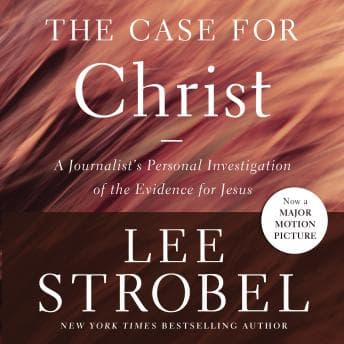

Okay, so I usually spend my time analyzing the twisted motivations of fictional serial killers or reading dry academic journals on cognitive dissonance. But sometimes—usually when my mother has been nagging me about "spiritual alignment"—I dip a toe into something different. Hence, The Case for Christ.
I listened to this while meal-prepping for the week (chana masala, if you're curious), and honestly? I had a similar experience with Get Sh*t Done—both books strip away the fluff and just lay out the evidence. It felt less like a religious text and more like a cold case investigation. Which, given my reading habits, is exactly my vibe.
The Detective in the Booth
Lee Strobel narrates this himself. Usually, I'm skeptical of author-narrators—unless it's a memoir, they often lack the acting chops. But here? It works. Because Strobel isn't trying to be an actor. He's a journalist. He's a former legal editor.
His voice has this specific cadence—authoritative, clipped, very "just the facts, ma'am." It sounds like he's sitting across a table from you in a diner, laying out his notes on a napkin, trying to convince you he's found the smoking gun. (Or the empty tomb, in this case.)
He doesn't do voices. He doesn't do drama. He just presents the argument. For a book that's essentially a series of interviews and evidence analysis, a theatrical narrator would've been distracting. Strobel sounds like he's trying to convince himself as much as he's trying to convince you. Psychologically, that makes the narrative way more compelling. You can hear the skepticism he started with.
When Logic Meets the Unexplainable
Here's what fascinated me from a behavioral perspective: The structure. Strobel approaches faith not through emotion—which is the standard route—but through rigorous, almost aggressive logic. He interviews experts with fancy degrees (Cambridge, Princeton, the works) and treats the New Testament like a crime scene.
There's a section on the medical evidence of the crucifixion. Fair warning: It is graphic. Like, CSI level graphic. I actually had to pause chopping onions because the description of the flogging and the physiology of death by crucifixion was intense. (Don't listen to that part while eating. Seriously.)
But it appeals to the analytical brain. If you're the type of person who needs data before you can feel anything—classic avoidant attachment style behavior, by the way—this approach is catnip. He breaks down the reliability of manuscripts and the psychological profile of the witnesses. He argues that the disciples wouldn't have died for a lie they knew was false. Psychologically? That tracks. People do terrible things for delusions, yes, but rarely for something they know is a fabrication.
Who Should Listen (And Who Should Skip)
If you're a skeptic who likes true crime or legal thrillers, you might find this weirdly satisfying—it scratches that itch for evidence. Skip it if you want emotional, devotional content or if you're already firmly decided either way; this is built for the analytically curious, not the already-converted or the immovably opposed.
Final Thoughts Over Cold Curry
Look, whether or not this book changes your entire worldview depends on where you're starting from. But as a study in how to build an argument? It's solid. Strobel respects the listener's intelligence. He doesn't say "just believe." He says, "look at this document."
It drags a little in the middle—some of the interviews feel repetitive—but the pacing is generally quick for a theology book. My therapist would probably say I'm intellectualizing spirituality to avoid feeling it. She's probably right. But if you want a logical, evidence-based deep dive into history's most famous figure, Strobel delivers.