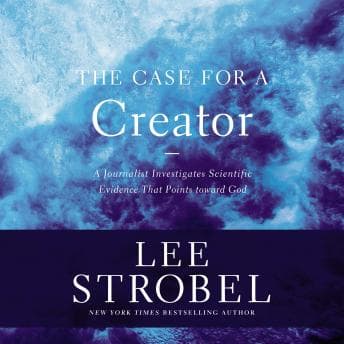

Can science lead you away from God and then bring you back? That's the question Lee Strobel wrestles with here, and honestly, it's the kind of intellectual journey I find myself thinking about during those long lakefront walks with Denise.
I came to this audiobook with some skepticism. Not about faith—I teach Dostoevsky, for crying out loud, the man couldn't write a grocery list without wrestling with the divine—but about whether apologetics books translate well to audio. Spiritual Exercises had the same challenge—dense theological material that demands your full attention. They tend to be citation-heavy. The kind of thing that works better when you can flip back three pages and check a reference.
When the Journalist Shows Up
Strobel's background as a legal editor at the Chicago Tribune actually serves him well here. The man knows how to structure an argument. He interviews scientists, philosophers, and researchers the way a good reporter would—asking the obvious follow-up questions, pushing back when answers get too abstract. It's accessible in a way that academic theology rarely is.
And here's the thing about Strobel narrating his own work: he sounds like exactly what he is. A journalist who found something that genuinely surprised him. There's no dramatic flair, no theatrical voice work. Just a guy walking you through his investigation. Some listeners find this formulaic—I get it. If you're coming from fiction audiobooks with full-cast productions, this will feel like listening to a really well-organized lecture.
But I've sat through enough faculty meetings to appreciate someone who can explain complex ideas without putting me to sleep. (Principal Martinez, I'm still not talking about your budget presentations.)
The Science That Made Me Stop Walking
The book covers a lot of ground—cosmology, cellular biology, DNA, consciousness. Strobel's approach is to let the experts do the heavy lifting while he plays the curious everyman. It works, mostly. The sections on the fine-tuning of the universe and the complexity of DNA are genuinely fascinating, the kind of material that makes you stop mid-stride and just stand there processing.
But here's where I have to be honest: this isn't going to convert skeptics. If you're coming in with serious doubts about intelligent design, Strobel's case probably won't close the deal. The scientific arguments are presented accessibly, but they're also presented selectively. He's building a case, not conducting a debate. That's fine—he's upfront about his purpose—but it means this works better as reinforcement for believers than as persuasion for doubters.
My students would probably roll their eyes at parts of this. They're skeptical of anything that smells like an agenda. But then again, my students roll their eyes at Thoreau, so their judgment isn't exactly my north star.
Strobel Behind the Microphone
Strobel reads at a pace that matches the material—measured, clear, giving you time to absorb the science before moving on. I listened at my usual 1.0x (yes, I know, I'm ancient) and it felt right. The production is clean, and there's a companion PDF with study materials if you want to dig deeper.
The weakness? There's not much variation in tone. Whether he's discussing the Big Bang or interviewing a biochemist, Strobel sounds pretty much the same. It's professional, but after eleven hours, you might find yourself wanting him to get a little more animated. When he describes the moment his atheism started cracking, I wanted to hear that in his voice. Instead, it reads like another paragraph in his investigation.
Your Commute, Your Call
This is ideal for commuters who want something intellectually engaging but not emotionally demanding. Great for believers who want scientific vocabulary for their faith. A solid resource for anyone curious about the intersection of science and religion, as long as you understand you're getting one perspective presented well, not a balanced debate. If you're looking for something less argumentative and more introspective, 5 Love Languages takes a gentler approach to faith-based guidance.
Skip it if you're looking for pure science or if apologetics makes you twitchy. And definitely skip it if you need dramatic narration to stay engaged—this is journalism, not performance.
Mr. Williams's Final Grade
I finished this during a week of grading sophomore essays on The Scarlet Letter. After reading forty variations of "Hester Prynne was a strong woman," Strobel's methodical investigation felt like intellectual relief. He's asking big questions and doing the work to answer them. Whether you agree with his conclusions or not, that's worth something.
The prose doesn't demand to be savored the way Faulkner does. But the ideas? Worth pausing the faculty meeting for.