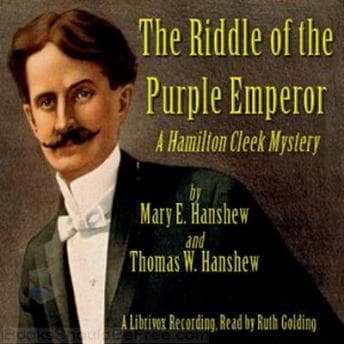

Everyone kept telling me this was a slow starter. I'd read that warning — "the first two chapters drag" — and almost moved on. But I was elbow-deep in a chicken tikka masala at 9 PM on a Tuesday, hands covered in turmeric, and needed something to fill the kitchen silence. So I hit play on Riddle of the Purple Emperor expecting to bail after chapter one.
I didn't bail.
A Jewel Stolen From a Temple and the Psychology It Drags Behind It
Here's what caught me immediately: the Purple Emperor itself. A priceless jewel looted from a temple during the Indian Mutiny, now sitting in the inheritance collection of a young English orphan. As someone whose parents grew up hearing stories about the lasting psychological wounds of colonialism, I found myself asking: why does this jewel function the way it does in the plot? Because it's not just a MacGuffin. It's a guilt object. Every character who touches it or wants it is acting out some version of entitlement, grief, or inherited trauma — even if Mary E. Hanshew (writing with Thomas W. Hanshew) wouldn't have framed it that way in the early 20th century.
Lady Margaret Cheyne returns on her eighteenth birthday to an embittered aunt and a lover with family baggage. The protagonist exhibits classic patterns of someone caught between duty and desire, but what's interesting is how the novel stacks the deck against her — the aunt's bitterness isn't random cruelty, it's the residue of a failed romance with Sir Edgar Brenton's father. That's generational damage playing out through drawing room manners and stolen glances. Psychologically, this tracks better than a lot of modern thrillers I've read.
Cleek, "The Man of Forty Faces," is the detective here, and he's a strange beast compared to his contemporaries. Where Poirot has vanity and Holmes has misanthropy, Cleek has this chameleon quality — literally, he can change his face. My therapist would have thoughts about this character. The constant shape-shifting reads like a man with no stable sense of self, which is a fascinating case study in how early detective fiction handled identity before we had the vocabulary for it. And his sidekick Dollops — perpetually hungry, cockney, loyal to a fault — functions almost as Cleek's emotional anchor, the one person who sees past the forty faces.
Ruth Golding's Voice and the Patience It Asks Of You
So about the narration. Ruth Golding is a LibriVox volunteer, and I want to be clear about what that means: this is not a studio-produced Audible original with a celebrity narrator and a sound engineer tweaking every breath. It's one person, reading into a microphone, doing it for free because they love books.
And honestly? Her voice is warm. Genuinely warm. There's an intimacy to her reading that bigger productions sometimes lose — she sounds like someone telling you a story, not performing one. The pacing in those first two chapters IS slow, I won't pretend otherwise. The Hanshews loved their scene-setting, and Golding doesn't rush through it. She lets the Victorian (well, Edwardian) prose breathe. If you're used to thriller narrators who hit you with urgency from sentence one, this will feel like wading through honey. That relentless urgency is what you get in Red Notice, which takes the opposite approach — all adrenaline, all the time.
But here's where I'll push back on the complaints: by chapter three, when the sinister chain of events kicks in, her steady pace becomes an asset. She's built enough atmosphere that the tension lands. I caught myself turning down the stove and just... standing there. Turmeric-stained hands forgotten. That's storytelling skill — not flashy, not dramatic, but effective.
What I can't tell you is how well she differentiates characters vocally. I didn't notice dramatic voice shifts between Lady Margaret and Dollops, which — given the class divide that's central to the story — felt like a missed opportunity. When your plot literally hinges on the gap between aristocracy and the cockney streets, I want to hear that gap.
Who This Is Actually For (And Who Should Keep Walking)
If you're a mystery reader who thinks the genre started with Gone Girl, skip this. Seriously. You'll hate it. The pacing is Victorian-era deliberate, the language is ornate, and nobody is an unreliable narrator in the contemporary sense.
But if you've ever loved Agatha Christie's quieter books — the ones where the psychology of the household matters more than the body count — this is worth your time. If you're a detective fiction completist who wants to understand what came between Sherlock Holmes and the Golden Age, Cleek is a missing link worth knowing.
And if you're the kind of person who listens while cooking alone on a weeknight and wants something that feels like company rather than entertainment? Ruth Golding's voice does that.
My Case Notes
This is a fascinating case study in early detective fiction that understands human motivation better than its reputation suggests. The colonial theft backstory, the generational romantic wounds, Cleek's identity fluidity — there's more psychological depth here than the penny-dreadful packaging implies. The narration asks for patience and rewards it, mostly. I wouldn't spend a credit on it when it's freely available through LibriVox, but I'm genuinely glad I spent a Tuesday night with it. The chicken tikka masala turned out great too.