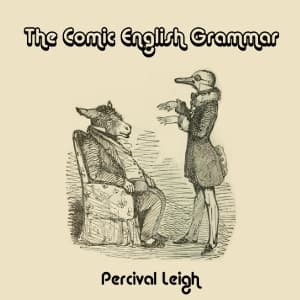

I was making dal makhani - the real kind, the one that takes three hours and your full attention - when I started this audiobook. And honestly? A Victorian grammar lesson paired with slow-simmered lentils felt weirdly appropriate. Both require patience. Both reward you eventually. Both will occasionally make you want to throw something.
Look, here's the thing about Comic English Grammar: the title is a bit of a lie. Percival Leigh, writing in 1840, clearly thought he was hilarious. He was... not. But that's actually what makes this interesting from a psychological perspective. What did Victorians find funny? What does humor reveal about a society's anxieties? (Don't tell my students I'm analyzing joke patterns in a grammar book. Though honestly, Talk Like TED taught me that analyzing communication patterns—even failed humor—is exactly how we understand what makes messages land. They'll think I've finally lost it.)
A Case Study in Victorian Superiority
Leigh was a Punch magazine contributor, which tracks. The whole text drips with that particular brand of British smugness that treats anyone who doesn't speak "proper" English as a moral failure. He's scathing about working-class speech patterns, absolutely ruthless about American English, and seems genuinely convinced that grammatical errors are symptoms of deeper character flaws.
Psychologically, this doesn't track - we know language variation has nothing to do with intelligence or worth. But watching Leigh construct his arguments reveals so much about how class anxiety operated in Victorian England. He's not just teaching grammar; he's policing social boundaries. The "comic" elements are really just elaborate ways of mocking people he considers beneath him.
Is it uncomfortable? Absolutely. But it's also a primary source document for understanding how language was weaponized as a class marker. I found myself asking: why did this kind of humor land in 1840? What made readers nod along instead of cringe? The research actually shows that prescriptive grammar movements often spike during periods of social mobility anxiety - when the "wrong" people might pass as educated. Leigh's book is a perfect specimen.
Ruth Golding Plays It Straight
Ruth Golding narrates this with admirable restraint. She doesn't try to make the jokes funnier than they are. She doesn't add dramatic flair or character voices. She just... reads it clearly, with good pacing and clean enunciation.
Some listeners might find this approach dry. Fair enough - if you're expecting a comedic performance, you'll be disappointed. But I think Golding made the right call. Trying to "perform" Leigh's humor would've been painful. Instead, she lets the text speak for itself, warts and all. Her straightforward delivery actually highlights how dated the material is, which - whether intentional or not - creates this interesting critical distance.
The production quality is clean (typical LibriVox standards), and at just under four hours, it doesn't overstay its welcome. I finished it over two cooking sessions and a morning jog through Cambridge.
Who Should Listen (And Who Should Skip)
This is not a grammar book you'd use to actually learn grammar. Modern resources are clearer, more accurate, and won't insult your American relatives. Skip it if smug Victorian classism is going to ruin your day, or if you want practical language instruction.
But if you're interested in the history of English language instruction? If you study Victorian literature and want to understand the cultural context of "proper" speech? If you're writing a paper on linguistic prescriptivism (like I maybe should be doing instead of listening to audiobooks)? This is genuinely useful primary source material.
The protagonist - and yes, I'm treating Leigh as a character in his own text - exhibits classic in-group/out-group psychology. He defines himself by who he's not. His identity as an educated gentleman depends on there being uneducated vulgarians to contrast against. It's a striking case study in how expertise gets tangled up with social status.
Would I Listen Again?
Probably not. Once was enough to extract what I needed. But I don't regret the time spent. Sometimes the most useful books are the ones that show you how people used to think - especially when that thinking was wrong. Leigh's confident wrongness about language and class is more instructive than any modern textbook could be.
My dal turned out great, by the way.